
Solar street-light manufacturer and project partner
Solar LED Street Lights & Complete Project Solutions
Solar lighting configured for your site, tender and budget.
LUXMAN manufactures solar LED street lights and configures the lighting, solar panels, batteries, controls and poles as a coordinated project package. Explore our product families, or bring your site or tender for a custom solution.
Find your starting point
Explore our solar street-light range
Browse standard families and specialist routes, then adapt the lighting, energy and mounting package to your project.
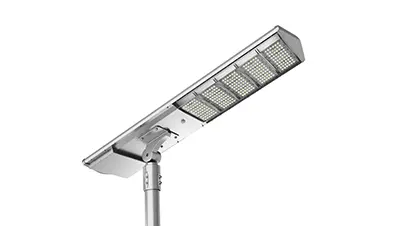
Compact integrated assembly
MY Series
4,000–10,000 lm
Start here for 4,000–10,000 lm MY01–MY04 options where the lamp position has clear solar access.
- Solar panel, LED and battery in one assembly
- Published MY01–MY04; 6000–7000K (OEM)
- LiFePO4 storage; lighting modes by configuration
When to compare another route: If the required output or site arrangement falls outside this range, compare MP, HS or a custom energy package.
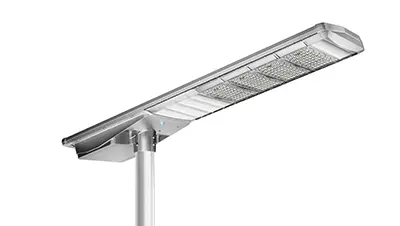
Integrated range to 15,000 lm
MP Series
4,000–15,000 lm
Compare MP when you need integrated options across 4,000–15,000 lm and a timing, sensing or mixed operating programme.
- Integrated solar street-light construction
- Published LX-LD01–06-MP; 6000–7000K (OEM)
- Remote-control options in the series documents
When to compare another route: If the required output exceeds the published range, compare HS or a custom configuration. If the lamp position is shaded, review a separate panel.
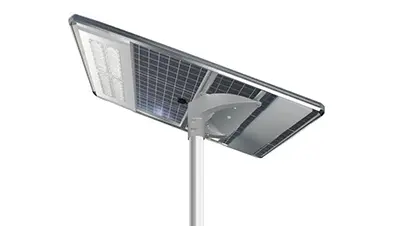
High-output integrated lighting
HS Series
15,000 / 18,000 / 22,000 lm
Compare HS for higher-output road and site duties after the lighting layout and operating hours are defined.
- LX-LD-80W-HS: 15,000 lm
- LX-LD-100W-HS: 18,000 lm
- LX-LD-120W-HS: 22,000 lm
When to compare another route: For a longer reserve or a different panel position, compare the complete optical and energy package rather than adding battery capacity alone.
HS model-table basis
Output values above refer to the linked 2024 HS specification, model table on page 7. Other published HS descriptions use a 20,000 lm series figure; quotations identify the exact model and specification revision.
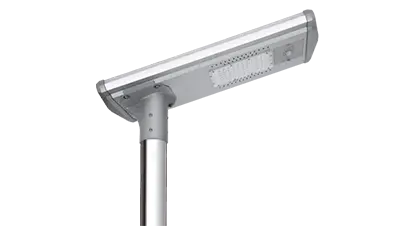
Drawer-style battery access
S3 Series
2,400–9,600 lm
Prioritise S3 when accessible battery replacement and a modular control arrangement matter to the maintenance team.
- All-in-one solar street-light family
- Published LiFePO4 battery configurations
- Drawer-style battery and modular control design
When to compare another route: Compare the actual output and service-access requirements with the other integrated families before choosing.
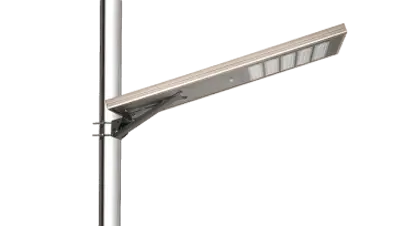
Dusk-to-dawn and sensing options
S2 Series
Integrated model and control options
Compare the S2 family for an integrated installation with dusk-to-dawn or sensing-based control.
- Solar-powered LED road-lighting family
- Dusk-to-dawn and sensing options
- Multiple output configurations in the series sheets
When to compare another route: Use the quoted model sheet to compare output, mounting and battery access; select another family when the site needs a separate panel or a different service arrangement.
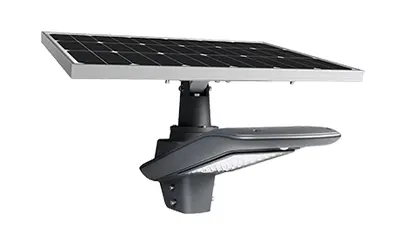
Independently positioned panel
SF Series
Separate-panel lighting system
Start with SF when the best panel orientation differs from the required light position.
- Separated photovoltaic panel arrangement
- Panel positioning can be considered separately
- Remote / APP options in the published family
When to compare another route: Allow for the panel bracket, cable route and service access; where solar access is clear at the lamp, an integrated assembly may reduce installation interfaces.
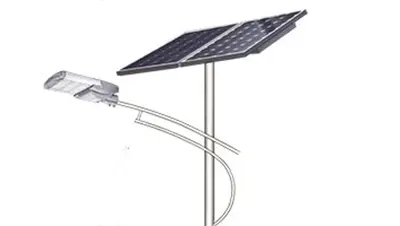
Landscape-oriented split arrangement
G2 Series
Split solar landscape-light route
Explore G2 where the appearance of the lighting installation and independent panel positioning both matter.
- Separate panel and lighting arrangement
- Visual integration for developed outdoor sites
- Project-specific mounting and energy configuration
When to compare another route: Review the proposed mounting and energy configuration against the actual site; use a road-focused family if the optical task calls for it.
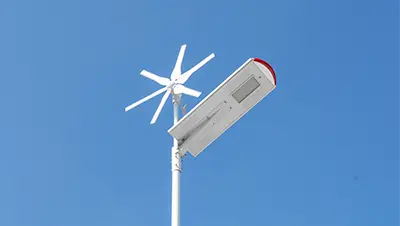
Wind and solar energy inputs
INF Series
Wind–solar hybrid system
Review INF for exposed locations with usable wind resources alongside the seasonal solar assessment.
- Solar module plus wind generation
- Storage and lighting form one energy system
- Wind equipment adds a maintenance consideration
When to compare another route: Compare the added generation with turbine servicing, structure and the local wind resource before choosing the hybrid route.
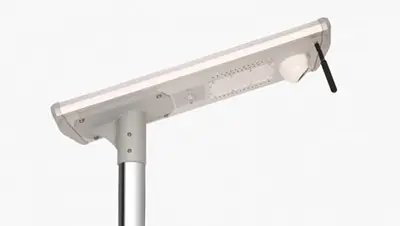
Lighting with camera options
S3C Series
Solar lighting + camera options
Review S3C for access points and outdoor sites needing lighting and a monitoring function.
- Combined lighting and surveillance route
- Connectivity selected for the site
- Lighting and camera loads budgeted separately
When to compare another route: Include camera and communications loads, connectivity and service needs in the energy package.
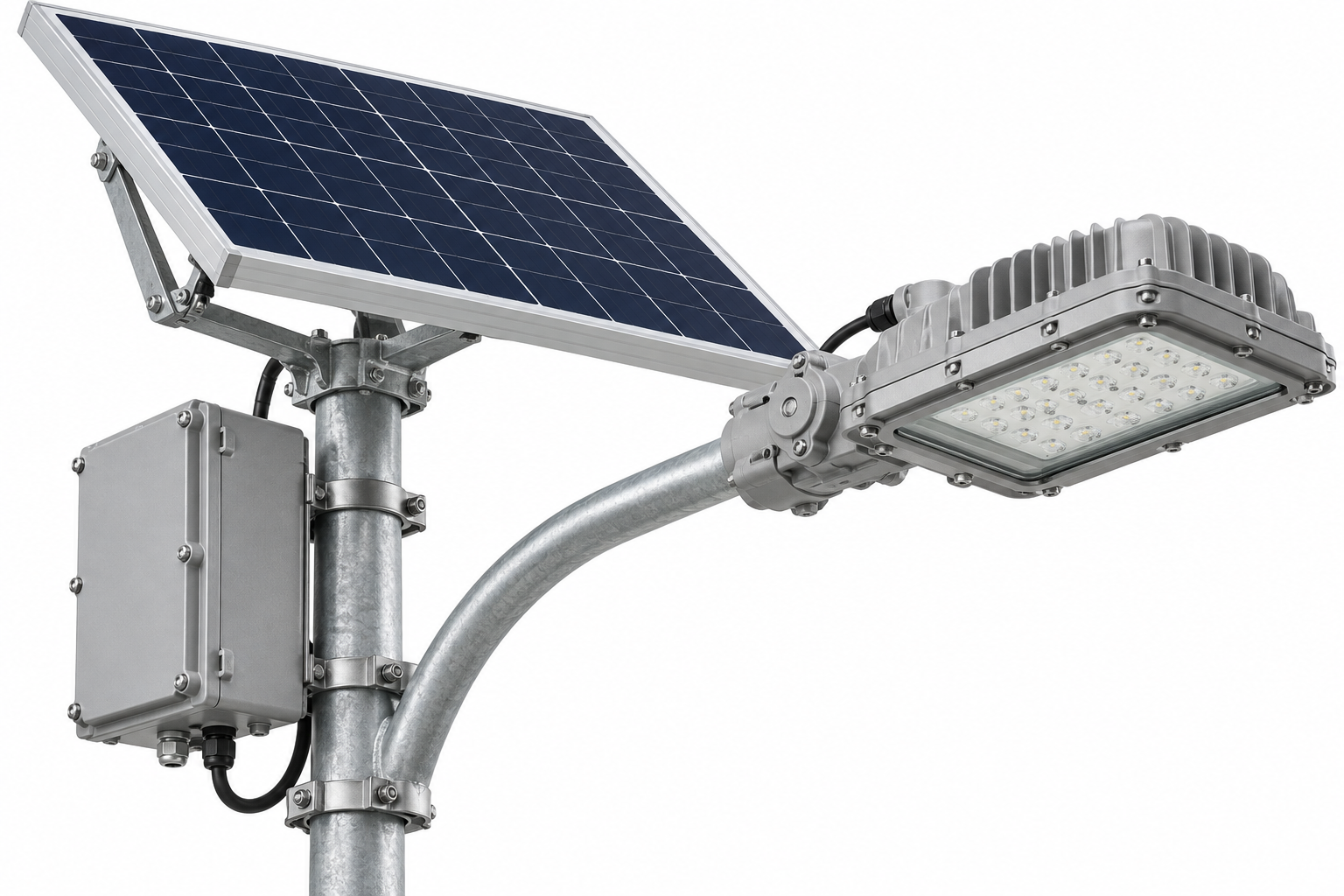
Hazardous-area project configuration
Explosion-proof solar street lights
Project-specific hazardous-area configuration
For a project requiring explosion-protected equipment, develop the lighting, storage and connection arrangement around the area classification.
- Solar-powered lighting for hazardous-area specifications
- Coordinate the light head, energy system and installation
- Confirm the approval scope for the actual supply configuration
Project review: Define which equipment is inside the classified area and which approvals apply to the supplied configuration.
No standard family matches these filters. Reset the filters or discuss a custom combination for your site.
Discuss a ConfigurationPublished model ranges are starting configurations. Your quotation identifies the selected components, specification revision, CCT and night programme.
All-in-one solar
A compact lamp assembly with integrated solar and storage components. Start here when the lamp position also offers good solar access.
Split / separate-panel
Consider panel positioning and luminaire positioning separately. Useful when their preferred orientations do not coincide.
Wind + solar
Combine renewable inputs where site wind and solar resources support the energy balance.
Lighting + CCTV
Bring lighting and monitoring into one project configuration when there is a real surveillance requirement.
Need a configuration beyond the catalogue? We can develop combinations around the required lighting result, night operation, site exposure and installation.
Published installations and application references
See how a site constraint changes the proposed solution, then explore references relevant to your project.
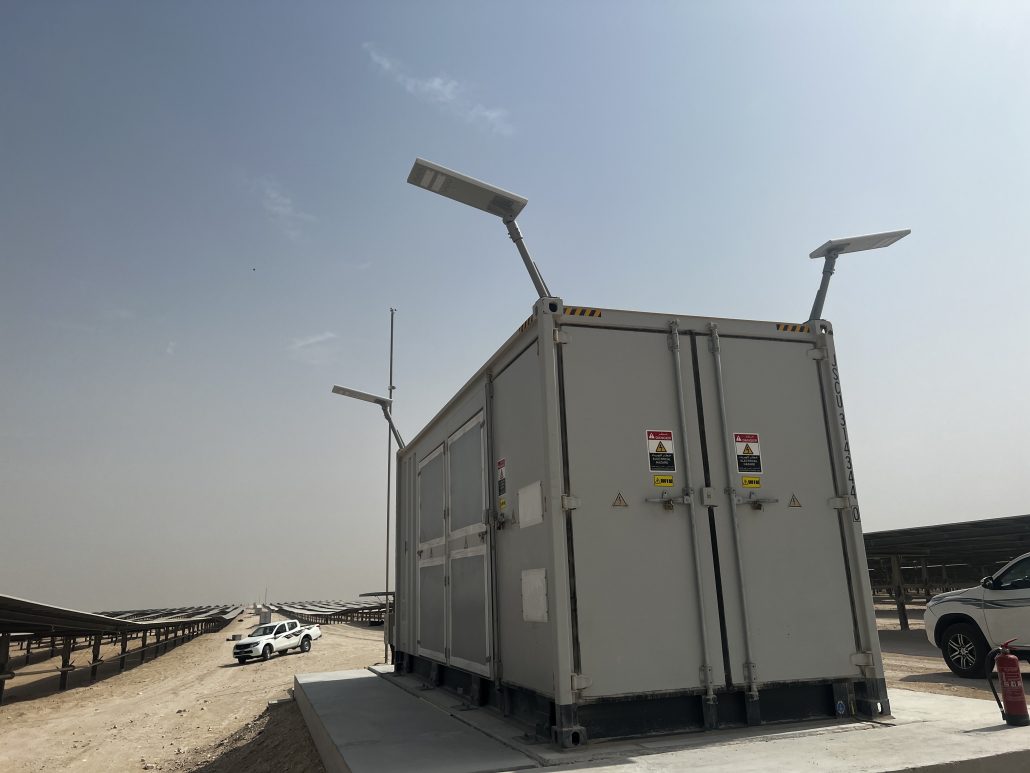
Published installation · Qatar, 2022
Al Kharsaah: lighting without welding to the containers
Site requirement: Fit lighting to existing project containers without welding or damage.
Solution: LUXMAN developed a bolt-on fixing accessory and adjustable mounting base.
Useful for your project: Resolve the fixing interface before approving a standard bracket for containers, shelters or existing structures.
View the mounting installation from another angle
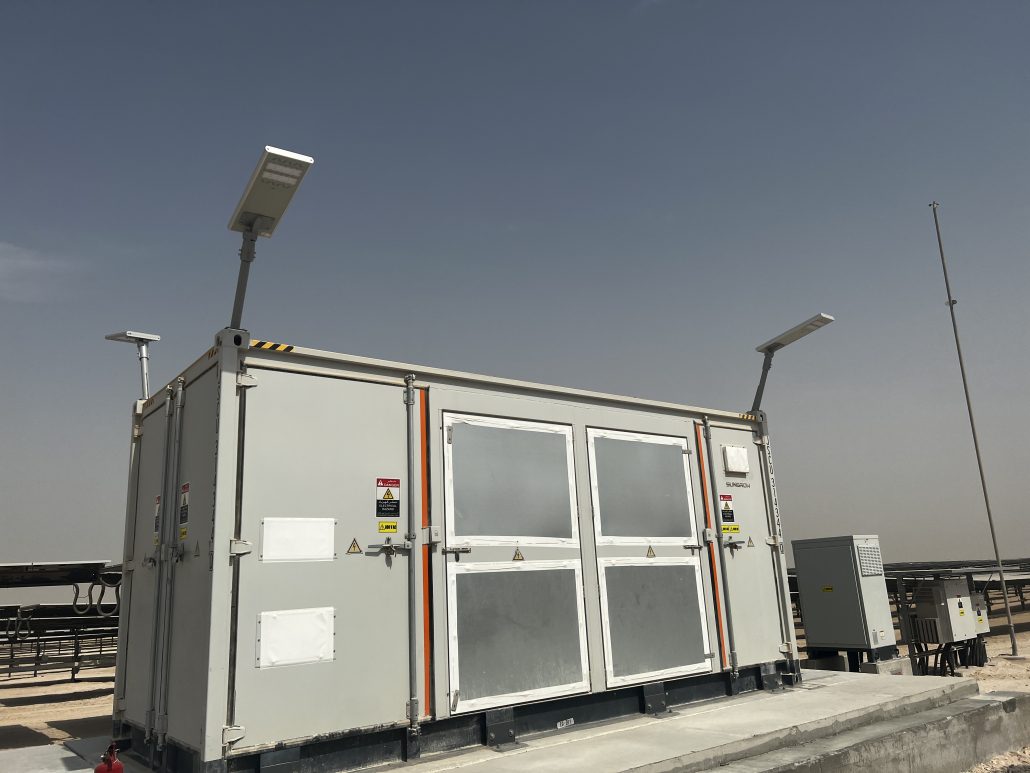

Published installation reference · campus
University campus: outdoor routes used after dark
Published reference: LUXMAN’s legacy application report identifies an installation at Nottingham University campus.
Project question: Coordinate circulation routes, evening use and the lighting/control arrangement.
Useful for your project: Start with the campus paths and operating hours; develop the layout and energy package for the actual location.
Explore more site types

Road & highway lighting
Extend road lighting where a grid connection is difficult or costly.
Road width, traffic task and mounting arrangement.

Island & coastal installations
Support lighting where grid access and frequent maintenance visits are limited.
Salt exposure, wind conditions, shading and maintenance interval.

Construction-site access lighting
Provide off-grid lighting for access and circulation during site development.
Fixed or moving task, obstructions and operating duration.

Parking & circulation areas
Light outdoor circulation and parking areas without assuming road optics fit every space.
Layout, occupancy, pole locations and surrounding properties.
More application and design guides
These resources discuss design questions for different settings.
Airports & service roads
Confirm the authority’s scope; road lighting is not aircraft guidance lighting.
Communities & residential roads
Consider glare at homes and maintenance responsibilities.
Industrial access roads
Separate traffic lighting from any hazardous-area classification.
Sports venues & access areas
Identify the specific road or outdoor task; do not assume sports-field compliance.
Reconstruction & rescue
Distinguish fixed road lighting from a relocatable light-tower requirement.
Six ways to configure a complete solar lighting solution
Choose the priorities that matter to your project. LUXMAN develops the optical, energy, mechanical and supply configuration together.
Light output, optics & colour temperature
7000K cold-white configurations are available. We propose luminaire output, CCT and optics around the required maintained lighting result, then check uniformity, glare and spill with the pole layout.
In your proposal: Selected CCT, luminaire lm and optic; maintained light level, uniformity and glare assessment.
Solar input, storage & reserve
We set the night hours and output, calculate usable storage for the selected reserve and size PV for both the seasonal load and charging recovery. Temperature and ageing allowances enter the final battery selection.
In your proposal: Battery Wh, panel Wp, night profile and backup/recovery conditions stated together.
Night operation & connected functions
We propose a control programme that preserves the applicable lighting requirement. Cameras, communications and battery heaters enter a separate load budget; they are not treated as free additions to the lamp.
In your proposal: An operating timetable, auxiliary-load allowance and the selected control functions.
Poles, layout & installation
We propose pole positions, height and spacing using the site geometry and photometric files. Arms, panel orientation, wind-exposed area, fixings and foundation interfaces are coordinated with the chosen energy package.
In your proposal: Proposed pole height and spacing, bracket schedule, and wind/foundation interfaces.
Environment & specialist protection
We select the enclosure, materials, protection and maintenance arrangement for the exposure. For hazardous areas, lighting, storage placement, controls and connections are defined against the required equipment-approval scope.
In your proposal: An itemised environmental specification and the applicable evidence/approval scope.
Complete supply, spares & service
We build the supply list around the selected configuration: luminaire, PV, storage, control, pole/arm, mounting parts, spares and agreed project documents. Civil works and installation responsibilities are identified separately.
In your proposal: A quotation with supplied items, interfaces, documents and by-others responsibilities.
CCT and luminaire output are specified separately. A 3-night or 7-night reserve target uses the agreed lighting schedule, starting charge and no-solar basis; seasonal charging and recovery are assessed alongside it.
How the choices work together
Homes and campus paths
Compare 3000K or 4000K where appropriate to the adopted requirements, with controlled distribution and shielding where light could reach occupied buildings.
The layout must preserve the required path/road lighting. Any scheduled dimming is then checked against the permitted night use before storage and PV are selected.
Proposed package: CCT and optic, layout/spill checks, operating schedule and energy configuration.
Access roads operating all night
Start from the maintained lighting result and full-night duty. Compare higher-efficacy luminaires, suitable optics and integrated or larger separate energy packages.
For a 7-night reserve target, compare storage and charging recovery while keeping the same required lighting schedule.
Proposed package: Photometric basis, night-output schedule, usable storage and seasonal recovery assessment.
Existing poles with shaded lamp positions
Keep the light over the required road area and assess a sunnier, separately positioned panel.
The split arrangement changes brackets, cable losses, structure loading and service access. Recheck the existing pole before approving the retrofit.
Proposed package: Lamp/PV positions, fixing and cable schedule, structural interfaces and energy package.
Worked example: compare 3-night and 7-night reserve on the same duty
Illustrative sizing calculation: a 50 W electrical load for 12 hours uses 600 Wh per night. Both reserve cases start with a full battery and no solar input. Assume 80% usable discharge and 90% battery-to-load delivery.
| Item | 3-night reserve | 7-night reserve |
|---|---|---|
| Same lighting duty | 50 W × 12 h = 600 Wh/night | 50 W × 12 h = 600 Wh/night |
| Energy delivered to the lamp over the reserve period | 1,800 Wh | 4,200 Wh |
| Calculated nominal battery, before cold/age margin | 2,500 Wh | 5,834 Wh (rounded up) |
| PV estimate to balance one normal night | 320 Wp | 320 Wp |
| PV estimate to refill the reserve in 2 days while still lighting each night | 800 Wp | 1,440 Wp |
PV estimates assume 2.5 equivalent peak-sun hours, 75% effective delivery and two recovery days while continuing the nightly duty. Battery Wh = nightly Wh × reserve nights ÷ (0.8 × 0.9). Recovery PV Wp = (nightly Wh + reserve Wh ÷ 2) ÷ (2.5 × 0.75). Final design includes site weather, temperature/ageing, auxiliary loads, controller and mechanical allowances.
Lighting with CCTV: account for both loads
Integrate the camera, communications, recording and lighting around one combined load budget. Illustrative load check: a 10 W auxiliary device operating 24 hours adds 240 Wh/day before supply losses.
A 50 W luminaire running 12 hours needs 600 Wh/night in the worked example. The additional device raises daily load to 840 Wh; storage and PV must be resized for the combined duty.
Proposed package: Separate lighting/auxiliary loads, the monitoring scope and a matching energy/control package.
Explosion-protected solar lighting
Develop the protected lighting and connection arrangement for the hazardous-area classification. Assess whether PV, storage and control equipment can be located outside the classified area, or require an approved in-area arrangement.
The placement and approval scope determine the permitted components, wiring, enclosure and mounting. IP protection alone does not establish explosion protection; a luminaire certificate does not cover the entire system.
Proposed package: An equipment/placement schedule and the conformity-document scope for the quoted arrangement.
A project offer your technical and procurement teams can review
Bring your tender or a site brief. We develop the proposed configuration and make the equipment, document and delivery scope explicit.
Technical response
Link mandatory clauses to the proposed model or custom configuration, evidence and any deviation. Identify specification conflicts before submitting the offer.
EPC and installation interfaces
Coordinate the luminaire, PV, battery, pole, brackets and installation interfaces. Separate equipment supply from foundations, site work and local approvals.
Purchasing and maintenance
Compare quotations on the same lighting duty, quantities and delivery scope. Identify spare assemblies, replacement access and the warranty/service responsibilities.
Choose the supply boundary
Lighting configuration
Specify the luminaire and solar energy system in an integrated or split arrangement. Agree the panel, battery, controls and mounting parts supplied with the selected configuration.
Retrofit existing poles or structures
Coordinate pole dimensions, brackets, panel position, cable routes and service access. Review the existing structure and foundations for the proposed assembly and site loads.
Complete set with light poles
Configure the solar lighting system together with poles, arms, brackets and agreed base/anchor interfaces. Define packaging, spares, documentation and shipping in the quotation.
| Decision | What the offer makes clear |
|---|---|
| Lighting and night operation | Selected CCT, model/optics and layout basis; output schedule; battery/PV, reserve and recharge assumptions. |
| Installation and quantities | Equipment/quantity list, pole and bracket interfaces; foundation/site work and supplied-by-others items. |
| Quotation and delivery | Base offer, approved alternatives, exclusions, delivery point and document/production/shipment milestones. |
| Maintenance and handover | Replaceable parts, optional spares, inspection/acceptance records and warranty, freight and on-site labour responsibilities. |
Preview the working format. View blank compliance, supply-interface, quotation and maintenance templates. They show how information can be organised; they are not completed project records.
Technical review checklist: eight project decisions
| Project risk | Decision to settle | Proposed response |
|---|---|---|
| Tender compliance & evidence | Which clauses are mandatory, which are scored, and do the specifications, BOQ, drawings and amendments agree? | A clause-linked compliance/deviation matrix and model-specific evidence index. Mark reports as available or requiring testing, with dates against bid submission; identify approval scope and discrepancies for clarification. |
| Road-lighting acceptance | What maintained light level, uniformity and glare criteria must the installed layout achieve—not just how many lumens leave the lamp? | A proposed lighting basis, optic and pole layout, with project photometric calculations and the acceptance method. Use maintained lux or road luminance (cd/m²) as applicable; watts enter the later load budget. |
| Night operation & energy reserve | Will the required light be maintained through the specified night and reserve period, with realistic seasonal charging and recovery? | A night/control profile and energy design covering usable battery Wh, PV, temperature, ageing and recovery. Define a 3-night or 7-night target under the same agreed lighting duty—not an unspecified rainy-day claim. |
| BOQ, poles & site interfaces | Are lamp, pole and bracket quantities correct, and who supplies the foundations, fixings, earthing, cables and installation? | An equipment/quantity schedule, pole and mounting drawings and an interface/responsibility list. Separate supply-only, retrofit and complete-set scope from civil works and local site approvals. |
| Approved configuration & change control | Will production match the evaluated offer, and what happens if a component or configuration changes? | A configuration/BOM baseline, sample or first-unit review and traceable revisions. Identify proposed substitutions and the resulting optical, energy, mechanical or document changes before approval. |
| Delivery sequence & inspection | Which dates refer to document approval, production, shipment or arrival at the named delivery point—and where are inspection hold points? | A proposed supply programme, packing/quantity schedule and inspection plan. State delivery terms and transport/tax responsibilities; distinguish factory checks from site acceptance. |
| Commissioning & handover | What must be demonstrated on site, what records are required, and who signs the installation and performance acceptance? | A commissioning/handover schedule naming who tests and signs. Record the agreed night-lighting measurement grid, readings and operating mode; define asset IDs, as-built information, manuals and training. |
| Warranty, spares & whole-life cost | Does the quote cover replacement parts, removal/refitting, transport or site visits—and what maintenance costs remain with the owner? | A service/spares schedule separating warranty repair, replacement and preventive maintenance. Compare equipment, logistics, installation, battery replacement and labour/access costs using the same evaluation period, currency and service boundary. |
If a BOQ, drawing or technical clause conflicts, we identify the discrepancy for formal clarification. A more efficient or easier-to-install alternative still needs the acceptance required by the tender; it is not substituted silently.
The quotation confirms document, testing and service scope, the approval schedule and supplier/EPC/local sign-off responsibilities. Reports and certificates identify the quoted configuration and applicable scope.
Information for each procurement stage
Before the specification is fixed
Send the location, road or site use, approximate dimensions and photographs. LUXMAN proposes the lighting criteria, layout, operating profile and supply route; you do not need to calculate lux or battery Ah first.
Preparing or responding to a tender
Send the current specification, BOQ, drawings, amendments, evaluation requirements and submission date. We develop the proposed technical response, identify clarification/evidence gaps and define the quoted supply/document scope.
After award or during execution
Send the approved equipment list and document revisions, site interfaces, quantities and delivery programme. We coordinate production, inspection and change approval with the agreed installation and handover responsibilities.

Manufacturing and project adaptation
LUXMAN operates a factory and develops standard products and custom combinations. The published manufacturing introduction describes electrical, waterproof and temperature test facilities.
Your project offer identifies the selected configuration, relevant test/document scope and any sample or approval milestones.

Turn four procurement decisions into a project brief
Use the optional selection sheet to organise your priorities. Save a PDF to share with your team or attach to an enquiry.
Keep the required light through the night
Agree the night output, hours and reserve basis before comparing batteries.
In your proposal: Night-output schedule, storage reserve and recharge assumptions.
Resolve installation interfaces before delivery
Identify the lamp, panel, pole and fixing arrangement before equipment is approved.
In your proposal: Mounting/interface schedule and supplied-by-others responsibilities.
Compare the complete project cost
Compare the same duty, quantities, equipment, freight and installation boundary.
In your proposal: Itemised base offer, exclusions and permitted alternatives.
Plan for practical local maintenance
Consider battery/controller access, replaceable assemblies and spare-part logistics.
In your proposal: Service/spares proposal and warranty, labour and freight responsibilities.
Where to look for savings while preserving the lighting result
| Your priority | What we compare | What the option must preserve |
|---|---|---|
| Reduce installation work | Compare integrated or pre-assembled packages, compatible pole interfaces and repeatable mounting details. | Keep good PV exposure and safe lifting/service access; a split panel can still be the better site fit. |
| Reduce total installed cost | Review optics and pole layout together, including lamp/pole quantities, foundations and installation access. | Any layout change must still meet maintained lighting, uniformity and glare criteria; wider spacing needs photometric support. |
| Keep the required light all night | Compare luminaire efficacy at the required light output and an appropriate battery/PV package. | Keep the agreed night profile and reserve basis. Include the control and recovery requirements in each option. |
| Reuse existing poles | Assess the existing pole, foundation and fixing interface before choosing retrofit brackets and panel positions. | Confirm condition, loading and compatibility; allow for replacement where the existing structure cannot support the package. |
| Reduce maintenance cost | Compare battery/controller access, replaceable assemblies, common spares and local replacement procedures. | Compare equipment cost together with access, labour, freight and service responsibilities over the same evaluation period. |
Poles, related equipment and technical resources
Use the dedicated ranges and guides for the next part of your project.
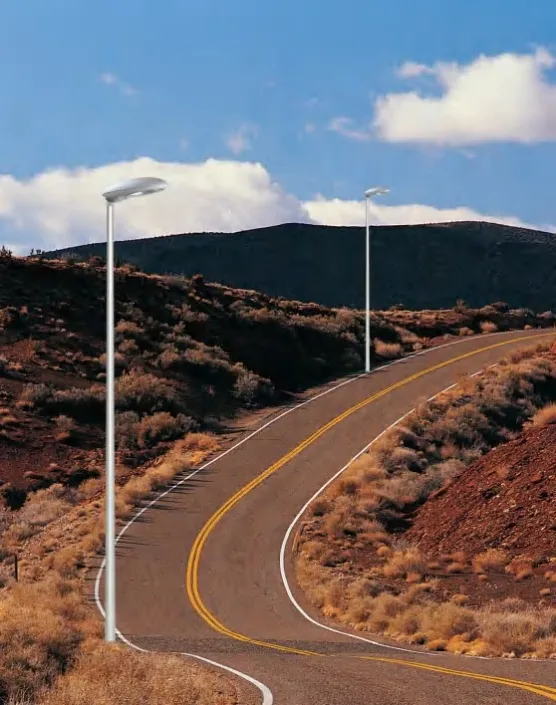
Aluminium light poles
Explore LUXMAN’s pole range as an independent product, or specify a pole as part of a solar lighting package. Coordinate height, arm/bracket, base interface, panel mounting and site loading.
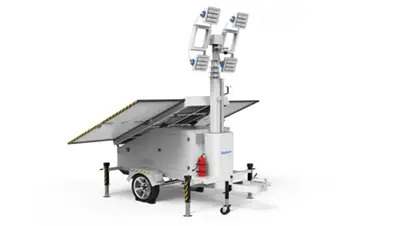
Mobile solar lighting towers
For jobs that need relocation and temporary site lighting, use the separate tower range—not a fixed street-light substitute.

Eagle Gen4 LED street lights
A mains-powered roadway luminaire route for sites using electrical infrastructure. This is not a solar-panel-and-battery model.

Solar-powered traffic lights
Solar traffic signal and warning-light products belong to a different visual and operating task from roadway illumination.

Solar flood lights
Separate solar floodlighting for building exteriors and local site areas. Select the optics for the task rather than the road-light title.
Technical guides
International frameworks and destination requirements
We start from the road/site task and the requirements adopted by the destination authority, then select optics, layout and the night programme. The energy and installation package follows that duty.
| Destination | Reference |
|---|---|
| International framework | CIE 115: choose the visual task and appropriate lighting evaluation. |
| Europe / UK | EN 13201 series, with the project’s adopted version and local requirements. |
| United States | ANSI/IES RP-8 and the requirements adopted by the relevant road authority. |
| Australia / New Zealand | AS/NZS 1158 with the relevant authority’s requirements; the linked M30 reference is specific to New Zealand. |
Road lighting may be evaluated using maintained illuminance or road luminance, with uniformity and glare criteria as applicable. There is no single global lux level, pole spacing or colour temperature for every road.
Questions before you request a quotation
What determines the price of a solar street-light project?
The required lighting result and night profile determine the optical and energy package; poles, mounting, environmental protection, quantities, destination and service scope also affect cost. Send your site or BOQ and any budget target. We can compare a proposed configuration with a cost-focused alternative while keeping the required lighting and approval conditions clear. Read the solar street-light cost guide for the main cost components.
How do I shortlist a product before I have a lighting design?
A project location, approximate road width and a photograph are enough to start; you do not need to pick a catalogue model first. LUXMAN proposes the applicable lighting criteria, CCT, optics, pole layout, night programme and a standard or custom energy package. Final lighting, structural and supply details are developed for the site, with the design/document scope stated in the quotation.
Can you follow our tender and offer an alternative configuration?
Yes. Send the current specification, BOQ, drawings, amendments and submission date. We prepare the proposed configuration and identify technical clarifications. Where alternatives are allowed, we can set out the changed components, cost drivers and performance implications beside the compliant proposal for your team’s review.
Do you supply solar street lights with built-in batteries?
The integrated families include published built-in battery configurations; MY and S3 documents list LiFePO4 storage. Confirm the chemistry, capacity, battery access and replacement arrangement for the exact quoted model.
Which waterproof or IP rating should I request?
Request the rating for the specified assembly and its supporting documentation. Published S2 and SF sheets list IP65; MY, MP, HS and S3 sheets list IP66. Include the specified assembly, connectors and control enclosures in the IP review. IP does not by itself establish corrosion or temperature suitability.
Will solar lighting operate all night through cloudy weather?
LUXMAN can develop 3-night or 7-night reserve configurations for the agreed operating profile. State the required light and night hours in the quotation; we size usable storage, seasonal PV input and charging recovery together. Reserve autonomy is assessed from a fully charged battery with no solar contribution. It is not a universal claim that every catalogue model runs at full output for seven rainy nights.
How should we evaluate a sample before a bulk order?
Agree the sample configuration and approval checks: review the relevant photometric documentation, verify the night-control settings, check the mounting fit and battery/controller access. Record the sample ID, accepted configuration and changes before bulk production. Send the intended quantity and destination so we can propose sample terms and a production schedule.
Get a Quote for Your Solar Street Lighting Project
Standard products, custom configurations and complete project supply. Tell us what you need, even if you have not selected a model.
Send a product enquiry, site photograph, quantity list or tender document. If you used the project selection sheet, email the saved PDF with your enquiry.