1. Overview and Design Objectives
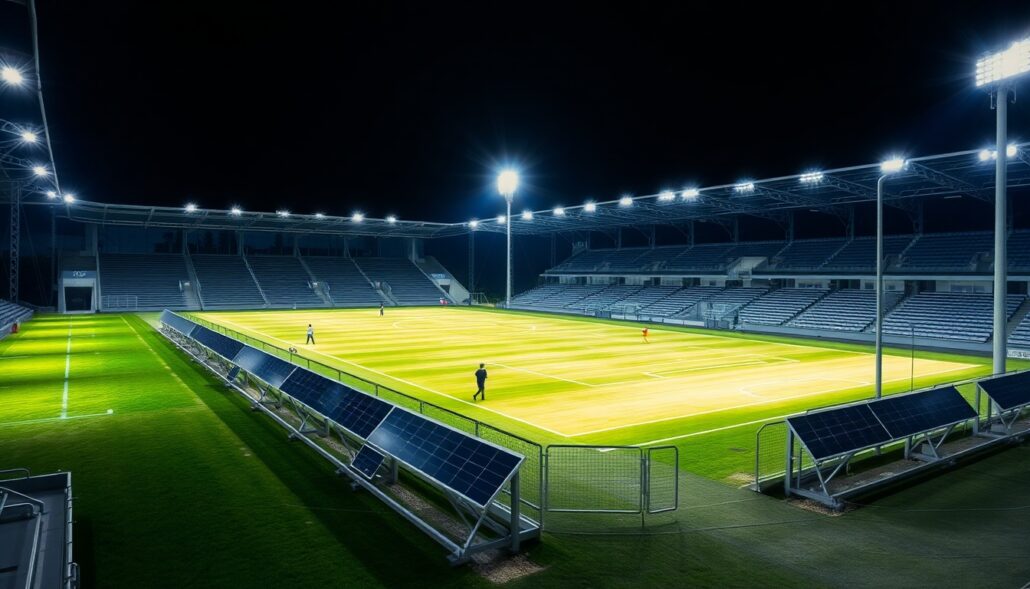
The lighting design for sports venues is a complex system engineering task that must meet multiple requirements, such as athletes’ visual performance, spectators’ viewing experience, and broadcasting quality, while achieving green, efficient, and intelligent energy utilization. The introduction of solar photovoltaic systems aims to construct a clean energy lighting solution that is off-grid or grid-assisted. The core objectives are:
to maximize the self-sufficiency of solar energy through optimized design, reduce long-term operating costs, and ensure system reliability and stability under various weather conditions while complying with international sports lighting standards.
2. Core Lighting Parameters Design (In Accordance with International Standards)
2.1 Luminance Selection: Illuminance (Lux), Luminous Flux (Lumens), and Uniformity
- Illuminance Standards and Levels: The illuminance design must be based on the venue’s purpose and the level of competition. According to FIFA and CIE standards, the levels can be categorized as follows:
- Training/Leisure Level: Average illuminance ≥ 200 lux.
- Amateur Competition Level: Average illuminance ≥ 500 lux, uniformity U1 ≥ 0.5.
- Professional Competition/Standard Broadcasting Level: Average illuminance ≥ 1000 lux, vertical illuminance ≥ 750 lux (crucial for broadcasting), uniformity U1 ≥ 0.7.
- HDTV Broadcasting/Top Competition Level: Average illuminance ≥ 1500-2000 lux, vertical illuminance ≥ 1400 lux, uniformity U1 ≥ 0.8.
- Luminous Flux and Light Efficiency: The total luminous flux (lumens) required is calculated based on the illuminance standards, area of the venue, and optical losses. To maximize solar energy utilization, high-efficiency LED fixtures must be selected. Currently, premium sports lighting LED modules can achieve luminous efficiency of up to 150-160 lm/W or higher. High efficiency means less power consumption to achieve the same illuminance, directly reducing the capacity requirements for solar photovoltaic components and storage batteries.
- Uniformity: Includes horizontal uniformity (U1 = minimum/average illuminance) and vertical uniformity. Poor uniformity can lead to visual fatigue, misjudgments, and affect the quality of broadcast images. The design should simulate using professional software to ensure that the above grading standards are met. The grid measurement method (e.g., 5m×5m) is an internationally recognized assessment method.
2.2 Color Temperature Selection
It is recommended to use color temperatures ranging from 4000K to 6000K, from neutral white to cool white. The current FIFA standard for top broadcasting events has adjusted the color temperature requirement from above 5500K to just above 4000K, allowing for the use of higher-efficiency light sources without affecting television broadcast quality. This temperature range provides a clear and bright visual environment, meeting the broadcasting requirements of most international events.
2.3 Color Rendering Index
For high-speed sports such as football and basketball, a color rendering index of Ra ≥ 80 is required; if there is a broadcasting requirement, it is recommended to aim for Ra ≥ 90. A high color rendering index accurately reflects athletes’ clothing, skin tones, and the colors of the venue, which is crucial for athletes’ judgment and the fidelity of broadcast colors. Special attention should be given to the LED light source’s R9 (red rendering index) to ensure that red objects are presented naturally.
2.4 Height Design and Pole Material
- Light Pole/Tower Height: The height design must meet illuminance uniformity and strictly control glare. International standards suggest that the angle (aiming angle) between the line connecting the fixture installation point and the center of the venue and the ground should be greater than 25 degrees to keep the glare index (GR) below 50 (more stringent for international events, typically GR ≤ 40). For football fields with a four-tower arrangement, the tower height (h) can be estimated using the formula h = d × tanΦ, where d is the distance from the center of the venue to the tower and Φ ≥ 25°. Generally, the tower height for an 11-a-side football field ranges between 25-35 meters.
- Pole Material: High-strength, corrosion-resistant materials such as hot-dip galvanized steel poles or aluminum alloy poles should be used. Given that sports venues are mostly outdoor environments, the corrosion resistance level of the poles (e.g., coating thickness) and wind resistance level (typically able to withstand the maximum wind speed occurring once in 30 years in the local area) are critical design factors. The pole structure must provide solid support for the installation and maintenance of photovoltaic components and heavy fixtures.
3. Hardware Configuration of Solar Street Lighting Systems
3.1 Photovoltaic Modules
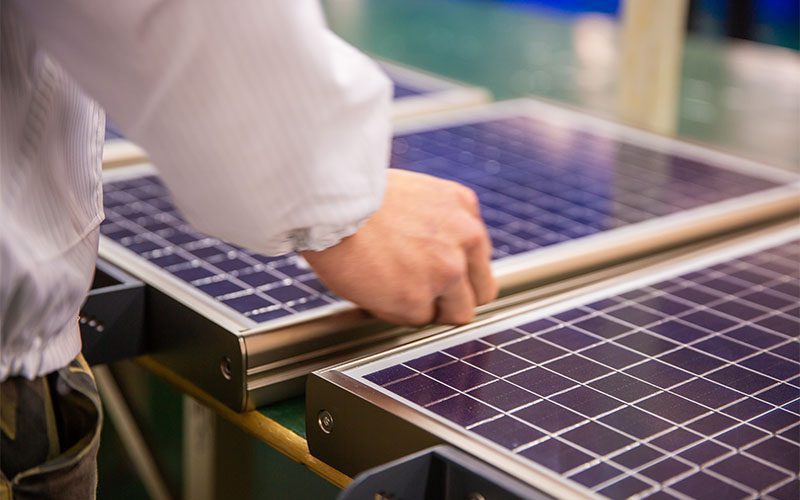
Based on the peak sunlight hours, total load power, and continuous rainy weather requirements of the venue location, calculate the total power required for photovoltaic panels. High-efficiency monocrystalline silicon photovoltaic modules should be used, and the installation angle should be optimized according to latitude. Consider installing on the top of the light pole integrated structure, grandstand roofing, or nearby building rooftops to ensure an unobstructed view.
3.2 Energy Storage System
- Battery Type: Preferably select Lithium Iron Phosphate (LiFePO4) batteries, as they have longer cycle lifetimes (typically 3000-6000 cycles), better high-temperature stability, and greater safety, suitable for daily deep cycle charging and discharging.
- Capacity Design: Battery capacity must meet the venue’s overnight full-load operational requirements for 3-5 consecutive rainy days. Capacity calculations should be based on daily lighting energy consumption, system voltage, and expected days of autonomy. For major event venues, configuring to higher standards (such as 5-7 days) is recommended, or designing a smart complementary system of solar energy and grid electricity to ensure reliability.
3.3 Smart Controller and LED Drive
The controller should have MPPT (Maximum Power Point Tracking) functionality to maximize photovoltaic efficiency and integrate multi-period and multi-brightness programming control. The LED driver power supply must match the fixtures, support stepless dimming, and meet low harmonic, high power factor (>0.95), and low flicker (SVM < 1.6) requirements, which are particularly important for high-definition slow-motion playback.
4. Intelligent Control and System Optimization
4.1 Automatic Lighting Control
- Preset Modes: The system should be able to switch between various lighting scenes with one button, such as “Training Mode” (30% brightness), “Competition Mode” (100% brightness), “Broadcast Mode” (100% brightness + specific vertical illumination), “Clear the Field Mode” (aisle lighting only).
- Intelligent Sensing and Dimming: Automatically turn on lights at dusk and off at dawn through light-sensitive sensors. Combine with personnel sensors to automatically reduce illuminance in non-primary areas during inactivity.
- Remote Monitoring and Management: Using an IoT platform, monitor the operational status, energy consumption, battery SOC (State of Charge), and photovoltaic power generation of each lamp in real-time, achieving fault warning and remote maintenance.
4.2 System Optimization Strategies
- Energy-Efficient Fixture Selection: Choose high-efficiency, precision light distribution (asymmetrical) LED sports lights such as the Greening Light GL-FL series to reduce energy consumption from the source.
- Dynamic Energy Management: The controller intelligently adjusts nighttime lighting power or operating time based on battery level and weather forecasts, prioritizing full load power supply during core competition periods and extending the system’s endurance on rainy days.
- Maintenance Factor Consideration: The design should reserve a maintenance factor (typically 0.55-0.7 for outdoors) to ensure that after fixture dust accumulation and light decay, the lighting levels can still meet standards.
5. Cost Analysis and Return on Investment
- Initial Investment Composition: Mainly includes high-efficiency LED sports fixtures, customized high poles and tower structures, photovoltaic modules, energy storage battery systems, smart control systems, and installation costs. Compared to pure grid electricity systems, the main additional item is the photovoltaic and storage parts.
- Operational Cost Savings: The solar energy system will significantly reduce or even eliminate nighttime lighting electricity expenses for the venue. Meanwhile, LED fixtures have long lifetimes (typically over 50,000 hours), with maintenance costs far lower than traditional metal halide lamps.
- Investment Return Analysis:
- Static Payback Period = Initial Incremental Investment / Average Annual Savings on Electricity and Maintenance.
- In areas rich in sunlight resources, the payback period is typically 5-8 years. Considering the lifespan of LED fixtures and batteries, the entire system can generate significant net benefits over its full life cycle.
- Additional Benefits: Complying with green building standards enhances the environmental image and social responsibility of the venue; ensures autonomous and safe lighting energy in regions with unstable power grids or remote areas.
Conclusion
Developing a successful solar lighting guideline for sports venues is crucial to adhere to international lighting standards and consider the characteristics of solar systems for integrated design. This requires cooperation between lighting designers, photovoltaic engineers, and structural engineers, ensuring that strict sports lighting quality indicators (illumination, uniformity, glare control, color rendering) are met while selecting high-performance, glare-free professional products like Yuedun sports lighting and optimizing energy collection, storage, and usage strategies, ultimately achieving a high-performance, high-reliability, high-benefit green smart sports lighting solution. Conducting detailed simulation calculations and full life cycle economic analysis in the project’s early stages is a necessary step to ensure its successful implementation.