Prepared by: Comwin Engineering Team
Date: [2026]
Contact: [Coco/Email: [email protected] Phone: +86 199 2517 6745] | Website: https://auto-odm.com/
Executive Summary
Comwin is proud to present our state-of-the-art BESS Container Assembly Line, a turnkey solution designed to revolutionize the production of Battery Energy Storage Systems (BESS) in containerized formats. As the demand for scalable, modular energy storage surges—with the global BESS market projected to exceed $20 billion by 2027 (BloombergNEF)—our assembly line addresses key challenges like efficiency, scalability, and compliance.
This proposal outlines the essentials of our BESS Container Assembly Line, including its processing workflow, key features, benefits, and implementation guidelines. Tailored for manufacturers in renewable energy, utilities, and industrial sectors, our solution enables rapid production of high-quality, containerized BESS units (e.g., 20ft or 40ft containers) with outputs ranging from 1 MWh/year to over 10 MWh/year. By partnering with Comwin, you can achieve up to 30% cost savings, faster time-to-market, and full compliance with standards like UL 9540 and IEC 62619.
Product Overview
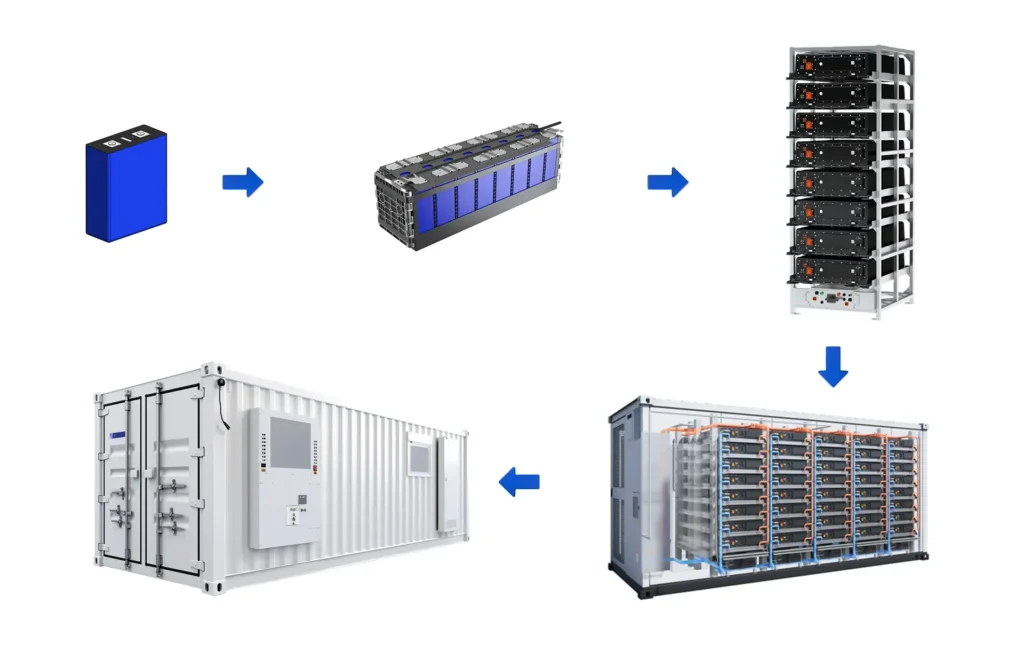
Comwin’s BESS Container Assembly Line is a hybrid automated system that integrates robotic precision with manual flexibility, specifically optimized for containerized BESS production. It supports various battery chemistries (e.g., LFP, NMC) and applications, from grid-scale storage to off-grid solutions.
Key Components
- Automation Modules: Robotic arms (e.g., ABB/Fanuc integration) for welding, stacking, and testing.
- MES Integration: Real-time Manufacturing Execution System for data tracking and quality control.
- Modular Stations: Scalable design allowing easy expansion or customization.
- Safety Features: Built-in fire suppression, airtight sealing, and compliance testing.
- Capacity Options: Basic (1-2 MWh/year), Standard (5 MWh/year), Advanced (10+ MWh/year).
Our line is engineered for seamless integration into existing facilities, with a compact footprint (e.g., 500-1000 sqm) and energy-efficient operations that reduce power consumption by 20-30%.
BESS Container Assembly Line Processing Workflow
The assembly line is divided into two main segments: Module and PACK, ensuring a streamlined workflow from raw cells to fully assembled containerized BESS units. Each step incorporates automation to minimize errors and maximize throughput (up to 50 modules/hour).
1. Module Segment: Cell-to-Module Assembly
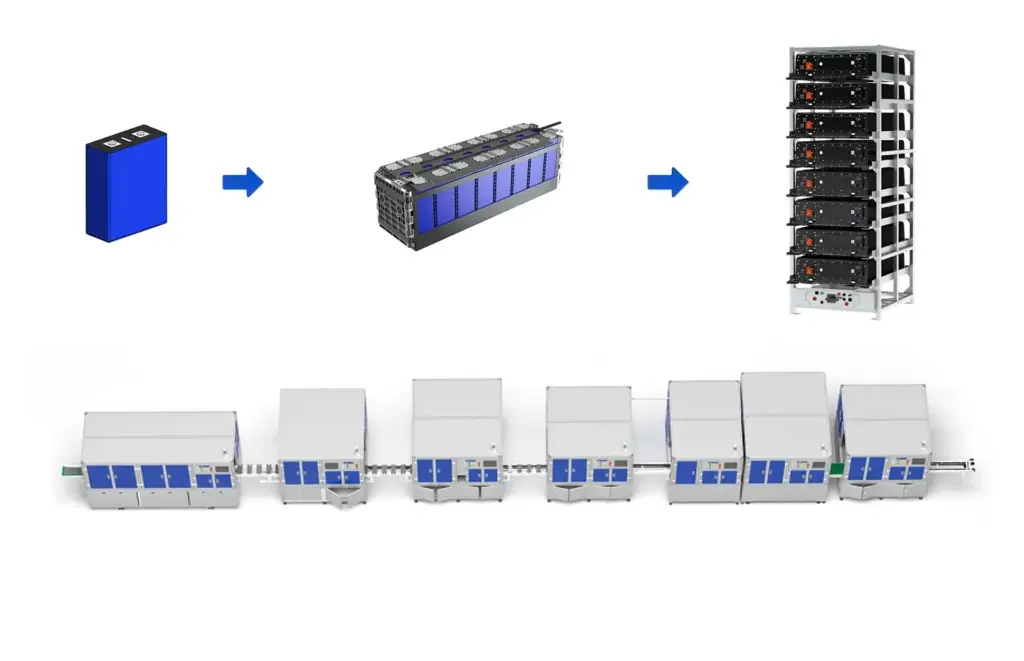
This phase builds the core battery modules, focusing on precision and quality.
- Step 1: Automated Cell Loading and Testing
Robotic feeders load cells, perform OCV (Open Circuit Voltage) testing, and group them by parameters. AI sensors detect defects with 99% accuracy, rejecting substandard cells early. - Step 2: Stacking and Welding
Cells are stacked uniformly using robotic arms, followed by laser welding of CCS (Cell Connection System) components. Manual stations allow for custom adjustments. - Step 3: Module Finishing and EOL Testing
Application of steel bands, insulation, and final tests for capacity, voltage, and thermal performance. Integrated MES logs all data for traceability.
2. PACK Segment: Module-to-Container Integration
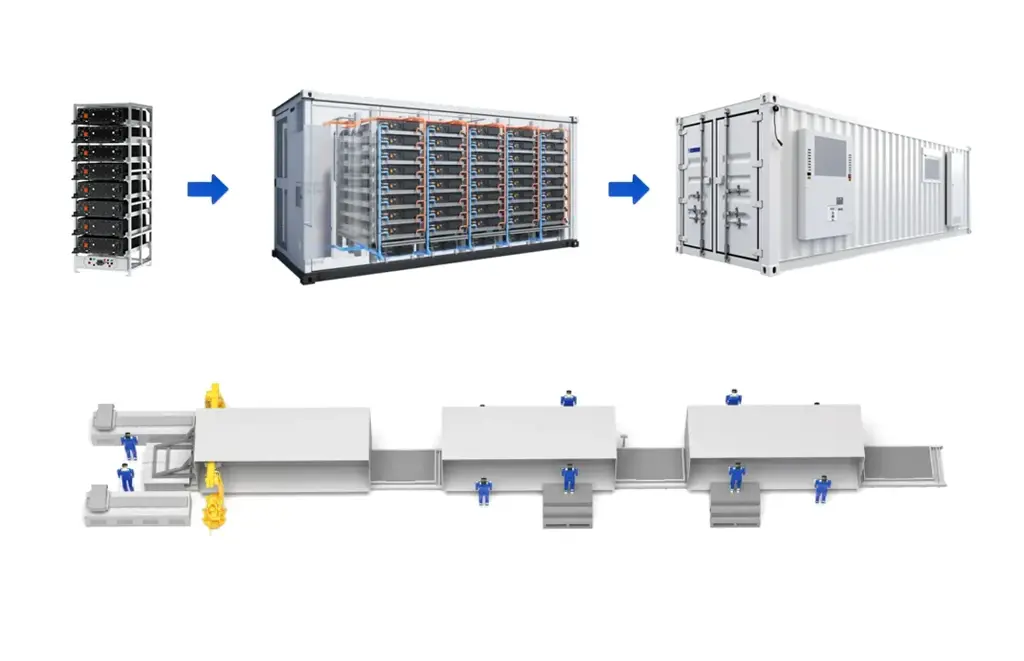
This phase assembles modules into a complete, containerized system, emphasizing durability for transport and deployment.
- Step 1: Enclosure Preparation
Manual loading of container frames with automated adhesive application for IP65-rated sealing and airtightness testing. - Step 2: Component Integration
Insertion of modules, wiring of BMS (Battery Management System), PCS (Power Conversion System), cooling units, and fire suppression. Robotic fastening ensures secure connections. - Step 3: Final PACK EOL Testing and Offloading
Comprehensive simulations of real-world conditions (e.g., thermal cycling, vibration). Qualified units are offloaded for packaging and shipment.
Total Cycle Time: 4-8 hours per container (depending on size and complexity). The workflow is fully traceable via IoT-enabled monitoring, allowing remote diagnostics.
Key Features and Benefits
Innovative Features
- Hybrid Automation: Combines robotics for high-volume tasks with manual stations for flexibility.
- Scalability: Modular design supports easy upgrades; add stations without downtime.
- Customization: Adaptable to container sizes (20ft-40ft) and specific requirements (e.g., marine-grade enclosures for offshore use).
- Sustainability: Eco-friendly processes reduce waste by 15-20% and align with ESG standards.
- Global Compliance: Meets UL, IEC, and CE certifications; includes risk assessment tools.
Tangible Benefits
- Efficiency Gains: Reduce production time by 40% and labor costs by 25% through automation.
- Cost Savings: Lower TCO with ROI in 12-24 months; energy-efficient design cuts operational expenses.
- Quality Assurance: Yield rates >95% with defect detection; real-world case: A European client scaled from 500 kWh/month to 2 MWh/month.
- Market Edge: Faster deployment (weeks vs. months) for grid, residential, or EV applications.
- Risk Mitigation: Built-in safety protocols prevent issues like thermal runaway.
Implementation and Support
Deployment Timeline
- Phase 1: Consultation and Design (2-4 weeks): Needs assessment, customization, and layout planning.
- Phase 2: Installation and Testing (4-6 weeks): On-site setup with factory acceptance testing (FAT).
- Phase 3: Training and Launch (2 weeks): Hands-on training for your team; pilot production run.
- Phase 4: Ongoing Support: 24/7 remote monitoring, annual maintenance, and upgrades.
BESS Container Assembly Line Pricing Structure (Indicative)
- Basic Line: $500,000 – $1,000,000 (1-2 GWh/year capacity).
- Standard Line: $1,500,000 – $3,000,000 (5 GWh/year).
- Advanced Line: $4,000,000+ (10+ GWh/year, full automation).
- Additional Services: Customization (+10-20%), Training ($10,000), Maintenance Contract ($30,000/year).
Pricing includes installation, 1-year warranty, and initial components. Contact us for a tailored quote based on your requirements.
Case Study: Successful Deployment
A mid-sized renewable energy firm in Asia implemented Comwin’s BESS Container Assembly Line to produce 40ft container units for solar farms. Results: 35% increase in output, 28% cost reduction, and compliance with local regulations. Within 6 months, they expanded to export markets, achieving a 150% ROI.
Why Choose Comwin BESS Container Assembly Line?
Comwin stands out as a trusted partner with over a decade of experience in battery automation. We’ve deployed solutions in 20+ countries, helping clients like solar integrators and utility providers lead the energy transition. Our commitment to innovation, reliability, and customer success ensures your BESS production is future-proof.
Next Steps and Call to Action
We’re excited to discuss how Comwin’s BESS Container Assembly Line can transform your operations. Schedule a free virtual demo or consultation today:
- Visit: https://auto-odm.com/bess-container-assembly-line-essentials-processing-workflow-and-how-to-choose-the-right-one/
- Email: [email protected]
- Phone: +86 199 2517 6745
Thank you for considering Comwin. Let’s power a sustainable future together!
Comwin – Innovating Energy Storage Solutions