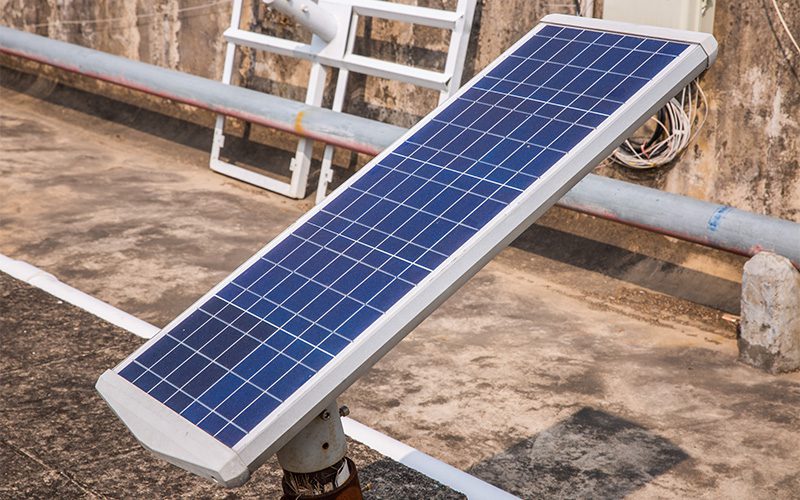
LUXMAN prices all-in-one solar street lighting by the project. You can request fixtures for existing poles, a supply package with new poles, or a quote that also defines the installation and commissioning scope. For a road project, start with the required lighting levels and operating hours. Once a 60W or 100W configuration meets those requirements, compare the cost of equipping the same stretch of road.
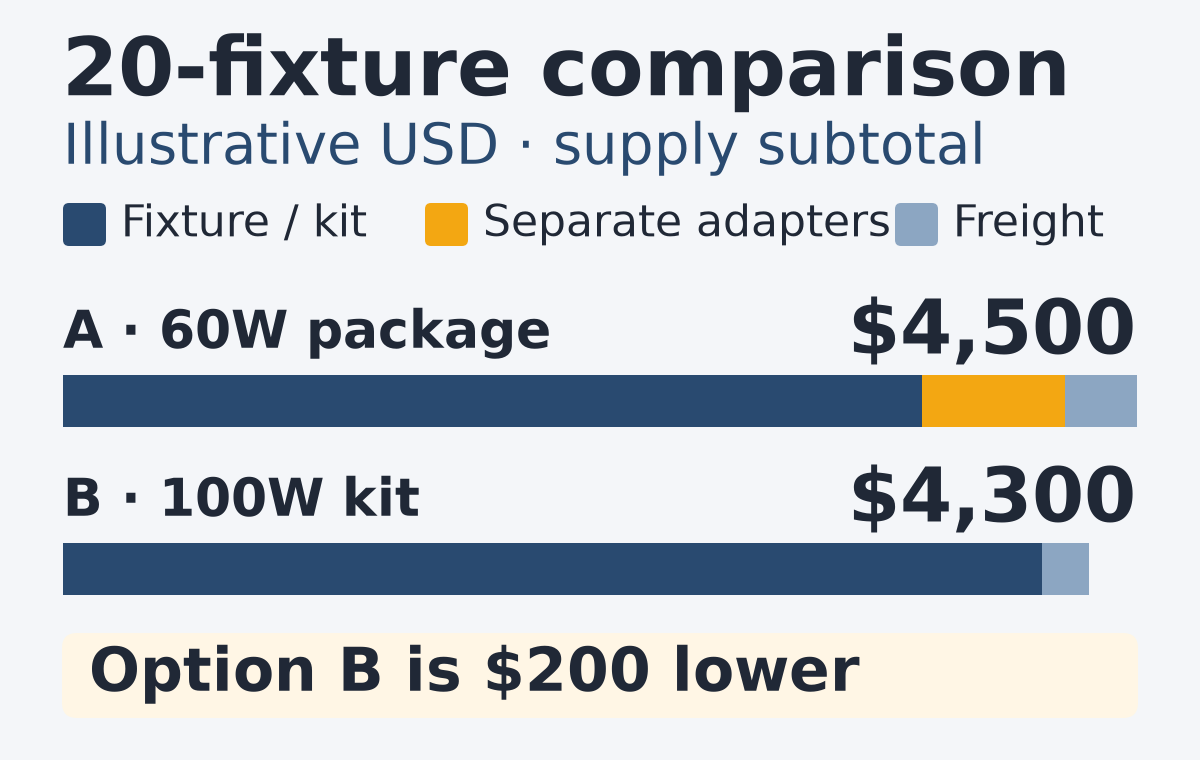
See how adapters and freight make the 100W package $200 cheaper for 20 fixtures (illustrative USD figures).
What does an integrated solar street light price include?
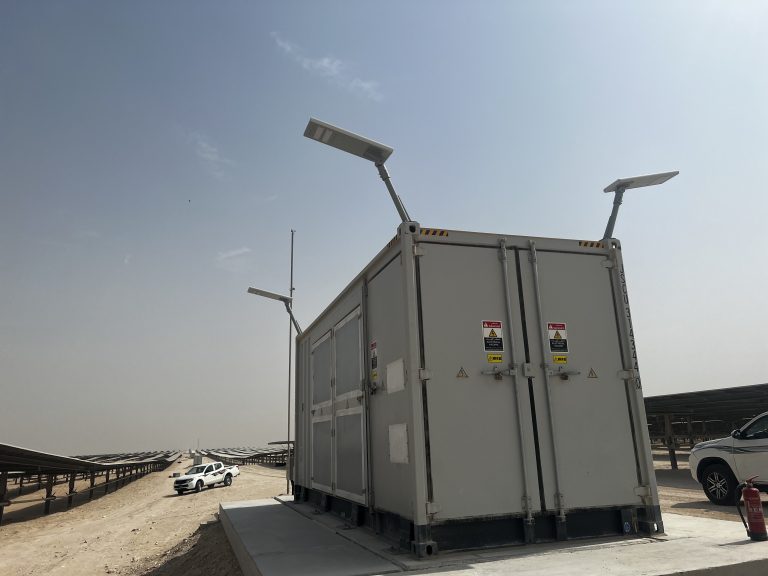
The LUXMAN MY Series combines the LED light, solar panel, battery and controller in one fixture.
For an existing pole, include a photo and the mounting diameter if you know it. LUXMAN can review the fit and quote the bracket or adapter the project needs. For new pole positions, ask for a package with the pole, mounting arm and anchor hardware itemized.
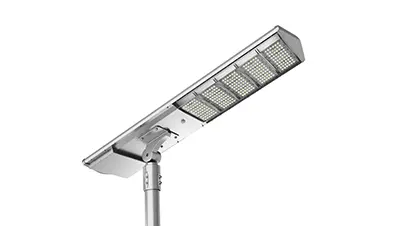
| Quote scope | What to request from LUXMAN | What to confirm before ordering |
|---|---|---|
| Fixture only | Integrated luminaire with its solar panel, battery and charge controller. | Exact ordering code, optic, programmed light levels, and whether the mounting arm or adapter comes with the fixture. If reusing poles, check the mounting diameter, existing condition and structural suitability. |
| Equipment with pole | Fixture and the specified pole. The quotation may include an arm, adapter or anchor hardware. | Pole height and specification, mounting interface, foundation and anchor hardware, and who supplies each. Confirm packing and delivery for the complete equipment list. |
| Installed package | Quoted equipment plus agreed installation and commissioning. The scope can use new or existing poles. | Who handles foundations, access equipment, aiming and programming, acceptance checks, and service calls. Itemize spare parts and clarify who covers warranty labor and freight. |
When asking LUXMAN to price a base configuration and an alternate, give both the same quantity, currency, delivery point and delivery terms. Ask for quote validity and separate lines for discounts, freight, duties and taxes. Mark each item as included, excluded or awaiting a price.
When should you choose 60W or 100W?
Start with the light the road needs, then use luminaire efficacy to work back to power. This example uses 130 lm/W as its comparison benchmark and 150–190 lm/W as the range for LUXMAN high-efficacy configurations. Confirm the total luminaire lumens and the electrical watts at the luminaire input for the exact optic, color temperature and operating setting in the quote.
Multiply luminaire input watts by efficacy to estimate fixture lumens. Divide the required lumens by efficacy to estimate input watts. At the 130 lm/W benchmark, a 100W fixture delivers 13,000 lm. The last column compares how much power each configuration needs to reach that same light output.
| Efficacy used for comparison | Lumens at 60W | Lumens at 100W | Watts for 10,000 lm | Watts for 13,000 lm |
|---|---|---|---|---|
| 130 lm/W · Comparison benchmark | 7,800 lm | 13,000 lm | 76.9 W | 100 W |
| 150 lm/W · LUXMAN calculation | 9,000 lm | 15,000 lm | 66.7 W | 86.7 W |
| 190 lm/W · LUXMAN calculation | 11,400 lm | 19,000 lm | 52.6 W | 68.4 W |
Two LUXMAN 100W models at their published ratings
The table above estimates output at assumed efficacies. These two models have their own published output values.
| Model and specification | Listed power | Listed light output |
|---|---|---|
| MY04 · MY specification, page 8 | 100 W | 10,000 lm |
| LX-LD-100W-HS · HS specification, page 7 | 100 W | 18,000 lm |
Shortlist MY04 if its output and optic fit the layout. If the preliminary calculation calls for more output, include HS in the comparison and rerun the layout with its photometric file. Ask for the ordering code, actual input power and output for each quoted configuration.
Use the project specification or road authority’s adopted criteria for maintained illuminance (lux) or road surface luminance (cd/m²), uniformity and glare. Compare the quoted IES or LDT files on the same road layout, pole positions, mounting height, tilt and maintenance assumptions. CIE road lighting guidance
When a 60W all-in-one solar street light makes sense
If preliminary photometry calls for about 10,000 lm per fixture, a 60W option needs at least 167 lm/W. At 150 lm/W, 60W yields 9,000 lm. Ask LUXMAN to check a 60W high-efficacy configuration before increasing input power. On an existing layout, recheck uniformity, glare, the scheduled nighttime output and the pole’s suitability for the fixture and bracket. If the layout shows dark gaps between poles, review the optic and spacing before raising power.
When a 100W all-in-one solar street light is worth quoting
Suppose a preliminary calculation selects a fixture rated at 13,000 lm for the proposed optic, mounting height and pole spacing. At 190 lm/W, a 60W fixture reaches 11,400 lm. Reaching 13,000 lm takes 100W at 130 lm/W or about 68–87 W at 150–190 lm/W. Ask LUXMAN to price the options in that output range. Run the lighting calculation again with each proposed optic, including options with the same lumen rating. If the proposal changes the number of poles or fixtures, compare the full bill for the same road segment.
The MY catalog lists 6,000 lm for the standard MY02 60W. For a high-efficacy option, request a specification for the exact configuration you are comparing. MY02 60W product page · MY04 100W product page
If both proposed configurations meet the lighting and runtime requirements, compare delivered price and maintenance costs. If neither meets them, ask LUXMAN to review the optics and pole layout and run the calculation again.

Compare the energy behind the wattage
At a constant 10,000 lm for eight hours, the example uses about 615 Wh at 130 lm/W, 533 Wh at 150 lm/W and 421 Wh at 190 lm/W at the luminaire input. That is about 13–32% less luminaire energy in the higher-efficacy cases. Use the actual nighttime schedule and system losses to size the battery and panel. In a quote, check whether the lower lighting load changes the required battery or panel, and compare those line items.
A higher-efficacy fixture may reduce the battery and solar-panel capacity needed for the same lighting schedule. LUXMAN can compare these configurations and itemize any changes in the quotation. Each proposal should state the nighttime light-output schedule, usable battery energy, low-sun reserve and recharge assumptions, so you can see whether a lower price still delivers the required lighting throughout the night.
20-fixture project example: compare 60W and 100W quotes
Suppose a road project needs 20 fixtures on existing poles. Both example options deliver 10,000 lm per fixture at the specified operating point. Assume both pass the same road-lighting calculation and fit the existing poles. The energy calculation assumes eight hours at that output, 90% efficiency from the battery terminals to the luminaire input and zero solar input. The prices are illustrative USD inputs with freight to the same delivery point. The subtotal excludes poles, duties, taxes and site work.
| Project line for 20 fixtures | A · 60W high-efficacy package | B · 100W package |
|---|---|---|
| Output and efficacy at the specified setting | 10,000 lm at 60W (~167 lm/W) | 10,000 lm at 100W (100 lm/W) |
| Eight-hour energy at the luminaire input | 480 Wh per fixture | 800 Wh per fixture |
| Calculated minimum battery output for one night | 534 Wh per fixture | 889 Wh per fixture |
| Quoted usable battery energy (Wh at design temperature and battery age) | Supplier to specify | Supplier to specify |
| Quoted solar panel and recharge basis (Wp, design-month charging and recovery time) | Supplier to specify | Supplier to specify |
| Illustrative unit price including light, panel, battery and controller | $180 | $205, with adapter included |
| Fixtures or kits for the order | 20 × $180 = $3,600 | 20 × $205 = $4,100 |
| Compatible adapters | 20 × $30 = $600 | Included in kit price |
| Freight for the full order | $300 | $200 |
| Comparable supply subtotal | $4,500 | $4,300 |
| Supply subtotal per fixture | $225 | $215 |
The 100W package is $200 lower on the illustrative supply subtotal. A starts $500 lower on the equipment line, then adds $600 for adapters and $100 more in freight. With the other prices held fixed, the two packages tie if A’s adapters cost $20 each. The 60W option uses 320 Wh less per fixture at the luminaire input over the same eight hours.
Use the lower subtotal to make the purchase decision once both quoted configurations pass the same lighting and mounting checks and substantiate the required night schedule, battery reserve and recharge. Until those items are confirmed, record the price difference and keep technical approval pending.
The one-night battery figures divide the eight-hour luminaire energy by 0.90 and round up to the next Wh. They cover the luminaire load for one night. Ask the supplier to size the quoted package for the required reserve period, site solar conditions, auxiliary loads, temperature and battery aging.
For an installed budget, add any applicable duties and taxes, then price the work outside both packages, such as lift hire, mounting, programming and acceptance checks. If another layout changes the fixture count or civil work, price its actual bill of quantities for the same road segment. Solar street light installation and project costs
Frequently asked questions
Can I use the example’s $215 or $225 per fixture for my budget?
Use those USD figures to see how adapters and freight affect the comparison. For your budget, ask for a current itemized quote for your configuration, quantity and named delivery point. Add applicable taxes, duties and any site work outside the offer.
How do I compare quotes for different delivery points?
Ask LUXMAN to price both configurations to the same named point using comparable terms. If one option ends at a port, add the remaining inland transport, clearance charges and any other costs you would pay to reach your destination.
Does the price of one sample apply to an order of 20?
Request a separate 20-unit quote with its validity date, minimum order quantity and production freight. Confirm whether the production fixtures include the same brackets, control settings and documentation as the sample.
How should I price battery replacement?
Request the replacement pack part number, its fit with the controller and an itemized spare price. Ask how technicians access the pack and who pays for lift hire, labor and shipping under warranty. Compare those costs separately over the same evaluation period.
Request a comparable project quote
Options for existing poles or new installations
Ask LUXMAN to quote the required luminaire output and input power alongside the current ordering code, optic, night settings and mounting package. If you are comparing standard MY models, start with the published wattage and lumen table. View the MY Series specification.
LUXMAN can propose a base configuration and an alternate on the same lighting brief. Ask for itemized fixture, pole and adapter costs, with delivery and installation responsibilities stated separately. Explore the all-in-one range.
Send the installation location, the quantity or approximate road length, and whether you have existing poles. If delivery ends somewhere else, include that destination so the freight quote covers the right route. Pole photos, dimensions and required lighting hours help when available.