Battery Pack Assembly Lines: A Practical Guide for the Precision Heart Driving the Future
- Email: [email protected]
- WeChat (Coco): +86 199 2517 6745
1. What is a Battery Pack Assembly Line?
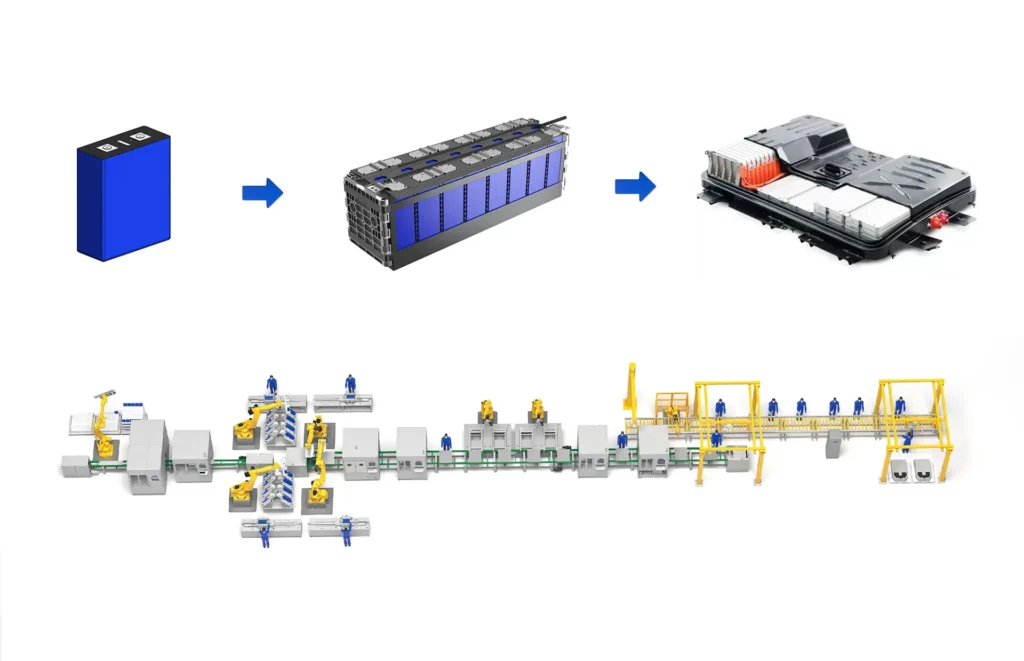
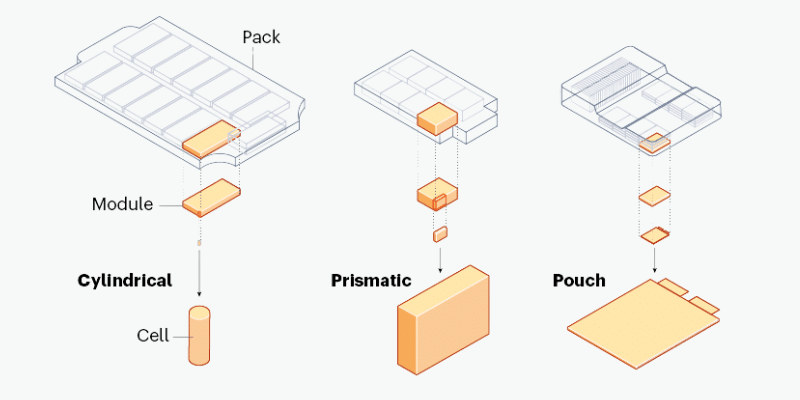
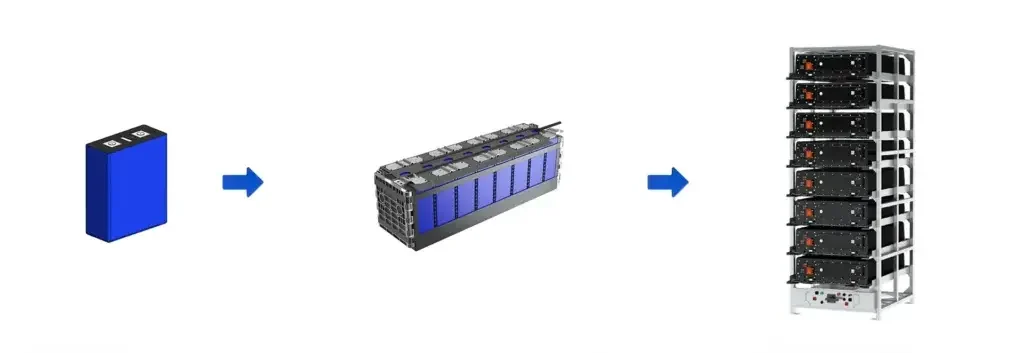
A battery assembly line, commonly referred to as a PACK line, takes screened lithium‑ion cells and, through a series of automated and semi‑automated processes, first assembles standardized cell modules and then combines multiple modules with the Battery Management System (BMS), thermal management, and structural housing to form a complete battery pack. Its core objective is to achieve high safety with high efficiency and high product consistency in high‑volume production. A state‑of‑the‑art line acts as the bridge between advanced cell technology and reliable end products, directly influencing pack energy density, cycle life, and safety.
2. How It Works: A Precise Journey from Single Cells to an Integrated System
Stage 1: Cell Preparation & Validation (Cell Feeding → OCV Testing)
The process begins with cell feeding. Typically, a pallet of cells is moved to the feed station by an AGV (Automated Guided Vehicle) or forklift. A six‑axis robot uses a vision system to precisely locate, pick up cells, and place them on the conveyor. Each cell then undergoes stringent Open‑Circuit Voltage (OCV) and Internal Resistance (IR) testing. This step is crucial to select cells with highly consistent voltage and resistance for module assembly, ensuring uniformity in the final pack. Cells failing the test are automatically rejected and replaced with qualified units.
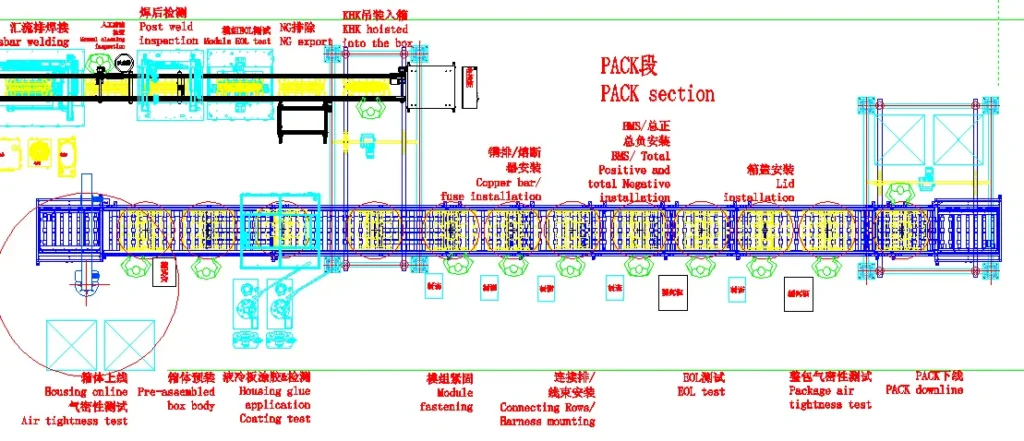
Stage 2: Module Core Assembly (Cell Adhesive Application → Module EOL Testing)
This stage builds the fundamental unit of the pack.
- Adhesive Application & Stacking: To fix the cells and enhance heat dissipation, robots apply structural or thermal adhesive on the cell faces. Cells are stacked in series or parallel as per design. After stacking, end plates and side plates are added and the bundle is tightened with straps or crimping to form a stable mechanical structure.
- Electrical Connections & Testing: Before welding, cell tabs are cleaned (e.g., plasma cleaning) to ensure weld quality. Then, using laser welding—the core technology—the busbars are securely welded to the cell tabs to realize electrical connections between cells. Laser welding concentrates energy with a small Heat‑Affected Zone, producing strong, low‑resistance welds. After welding, the module undergoes its first full offline testing (Module EOL Testing), including weld quality checks, module voltage and resistance checks, insulation withstand testing, and more, to ensure each module is a qualified semi‑finished product.
Stage 3: System Integration (Module Off-Line → Liquid Cooling Plate Adhesive Application)
This stage assembles qualified modules into a complete battery pack.
- Box Preparation & Module Loading: The pack housing goes online, and liquid cooling plates or other thermal management components may be pre‑installed. Modules are precisely hoisted or placed inside the housing.
- Final Assembly & Sealing: Operators or robots install high‑voltage connectors, the Battery Management System (BMS) wiring, Battery Disconnect Units (BDU), etc. Before closing the top cover, sealant is dispensed at the housing flange to prepare for final airtightness testing.
Stage 4: Comprehensive Validation & End-of-Line (PACK EOL Testing → Complete Package Airtightness Testing → PACK Off‑Line)
This is the factory’s final performance assessment before shipment.
- Final Performance Testing: The battery pack is connected to test equipment for complete charge–discharge cycling (aging tests) to activate cells, calibrate the BMS SOC, and screen potential defects. Comprehensive electrical safety tests, such as insulation withstand testing, are also conducted.
- Airtightness Testing: A critical safety line. By introducing a test gas (e.g., helium) into the pack and monitoring pressure decay, the integrity of the pack’s sealing is verified, ensuring attainment of IP67 or higher dust and water ingress resistance.
- Off‑Line: Packs passing all tests receive a unique serial code, and data are uploaded to the Manufacturing Execution System (MES) for full lifecycle traceability, then go offline for shipment.
3. Operational Benefits: Why Invest in an Advanced Assembly Line?
- Consistent Quality: Automated equipment minimizes variation from manual handling. From precise cell sorting and uniform adhesive application to repeatable laser welding, each step supports product uniformity. Online testing (OCV, EOL, airtightness) helps catch defects before shipment, aligning with industry best practices.
- Enhanced Safety: The line integrates multiple safety verifications. Insulation withstand testing prevents leakage, airtightness testing ensures reliable sealing in harsh environments, and thorough BMS validation provides smart monitoring and protection during use.
- Productivity & Scalability: Highly automated lines with AGVs and robots enable around‑the‑clock operation, boosting capacity. Flexible designs allow rapid adaptation to different cell and pack models by adjusting fixtures and programs to meet evolving market needs.
- Traceability & Data‑Driven Improvement: An MES backbone records production data and test results for every cell, module, and final pack, enabling end‑to‑end traceability and providing a solid foundation for process optimization, defect analysis, and predictive maintenance.
4. Industry Perspective: Comwin’s Custom Solutions for Prismatic Battery Lines
Comwin contributes practical, tailored solutions for prismatic battery assembly lines. This guest post highlights a capabilities‑focused approach to line design, process integration, and automation, with an emphasis on reliability, cost efficiency, and scalable throughput. If you have questions or require a tailored solution, please consider reaching out.
- What we offer: Process assessment, line design, equipment selection, automated integration, and seamless MES interoperability. We tailor processes and equipment layouts to suit different models, capacities, and thermal management needs to achieve higher yields and lower production costs.
For tailored solutions and implementation details, please contact:
- Email: [email protected]
- WeChat (Coco): +86 199 2517 6745