A mobile lighting tower should be selected as a complete working system, not by lamp wattage alone. The right configuration must deliver the required illuminance across the work area, operate for the full shift, remain stable when the mast is raised, move safely across the intended terrain, and match local environmental and transport requirements. Start with the site and task; choose the power source and tower configuration only after those inputs are clear.
What Is a Mobile Lighting Tower?
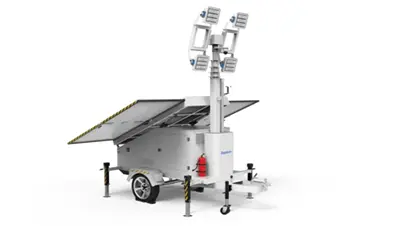
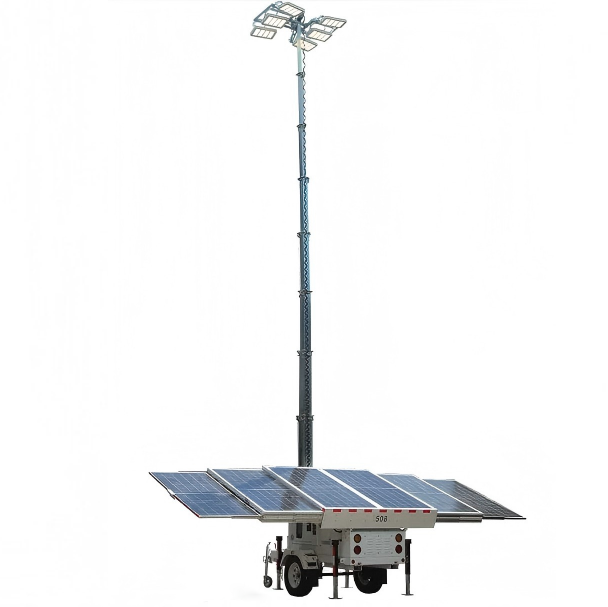
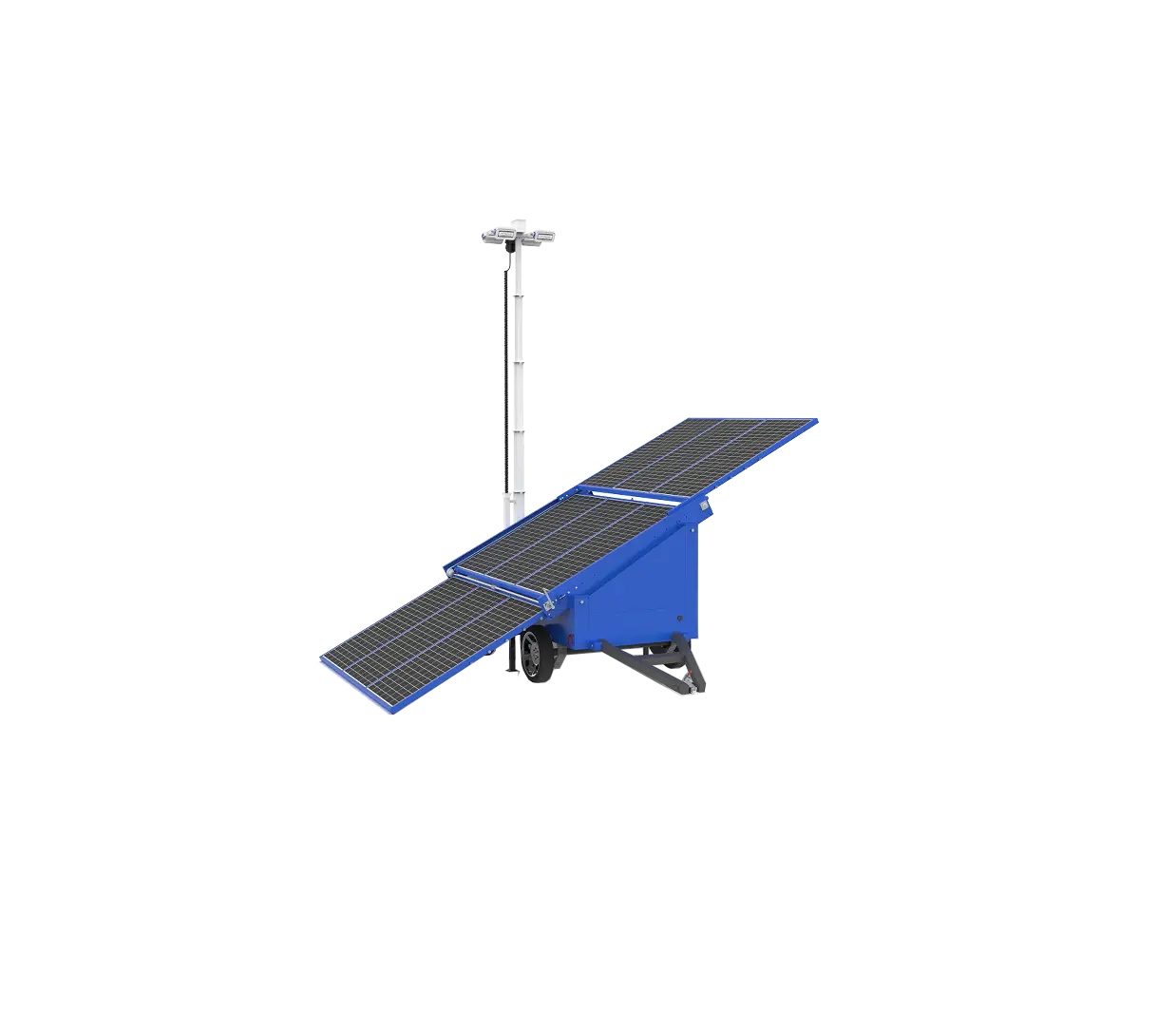
A mobile lighting tower raises one or more luminaires above a work area on a transportable mast. Depending on the configuration, it may use solar-battery storage, mains electricity, a generator, wind assistance or a hybrid energy system. Trailer-mounted, skid-mounted and hand-push designs support different access and relocation needs.
The terms برج الإضاءة, portable light tower, mobile light tower و tower light often describe this equipment category, but actual products differ in energy source, runtime, mast mechanism, chassis, wind limits and road-use status.
The most important selection question is therefore not “Which tower is brightest?” It is:
Which lighting, energy, mast and mobility configuration can complete the required task under the site’s real operating conditions?
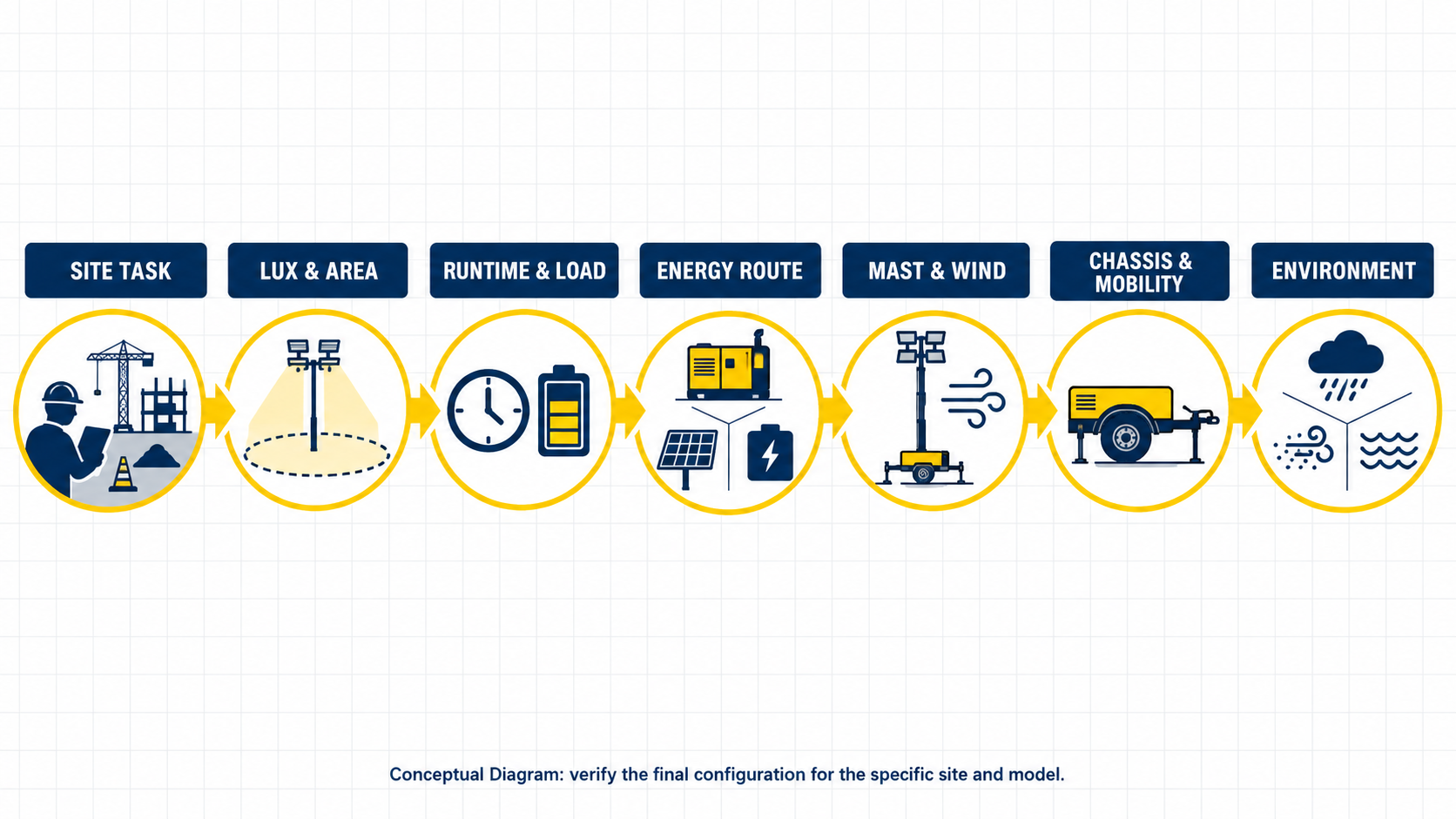
The Seven Inputs That Determine the Right Lighting Tower
Direct answer: Do not select a lighting tower by lamp wattage alone. Match seven inputs—the work task, area geometry, shift profile, available energy, mast and wind conditions, mobility requirements, and operating environment—before comparing models.
1. Work task and required visibility
General vehicle movement, pedestrian access, loading, excavation, inspection and precision maintenance do not require the same lighting quality. Define what people and machines must be able to see, then identify the applicable illuminance and uniformity requirements for the project location.
Watts describe electrical input. Lumens describe emitted light. Lux describes how much light reaches a surface. None of these values alone guarantees useful visibility. Beam distribution, aiming angle, mast height, obstructions, surface reflectance, glare and maintenance conditions all affect the result.
2. Work-area geometry
Record the area’s length, width, changes in elevation, equipment routes, stockpiles and shadow-producing structures. A long haul road, a square loading yard and a deep excavation may have similar area figures but require different tower positions and optics.
For projects where lighting affects safety or compliance, request a lighting calculation or verify the final arrangement with field measurements. A supplier’s stated “coverage area” is not automatically the area that will meet your required lux and uniformity.
3. Shift length and operating profile
Specify the number of operating hours per night, the days per week, seasonal changes and whether full output is required for the entire shift. Also list any auxiliary loads, including cameras, communication equipment, tools or external AC sockets.
For battery-based systems, a simplified starting point is:
Daily energy demand (Wh) = total operating load (W) × operating time (h)
The actual battery requirement must also account for usable depth of discharge, conversion losses, temperature, battery ageing, dimming and the required reserve period.
4. Available energy and site restrictions
Check whether grid power is available and reliable. For off-grid sites, record solar resource, weather patterns, fuel access, noise limits, emissions requirements and maintenance capability.
If a site has good solar access, a predictable nightly load and adequate charging time, a solar-battery tower may reduce fuel handling and routine engine maintenance. If continuous operation is critical through prolonged poor weather, additional storage or a verified backup source may be required. Diesel or hybrid systems may remain appropriate where energy demand is high and refuelling infrastructure already exists.
5. Mast, stability and wind conditions
Mast height influences coverage, shadow length and the size of the structure exposed to wind. Confirm the working height, lifting mechanism, locking method, luminaire adjustment, outrigger footprint and permitted wind conditions in the fully deployed state.
Wind claims must identify the exact model and test or calculation basis. They should also state whether the mast was raised or lowered, whether outriggers and anchors were used, and what ground conditions were assumed.
6. Mobility and road requirements
Choose among trailer-mounted, skid-mounted and hand-push designs according to relocation frequency, access width, ground condition and towing route.
A unit used only inside a mine or construction site may need off-road clearance, reinforced suspension and puncture-resistant tyres. A tower towed on public roads must also comply with the destination market’s requirements for the axle, tyres, brakes, coupling, lights, reflectors, dimensions and vehicle approval. A stated maximum towing speed is not, by itself, proof of road legality.
7. Environment and service access
Temperature, dust, rain, salt, chemicals and abrasive material affect enclosures, coatings, connectors and moving parts. Confirm which component or enclosure an IP rating applies to. For corrosion protection, review the substrate preparation, galvanising or coating system, exposed hardware and the actual test standard instead of relying on a general “anti-corrosion” label.
Service access also matters. Separate electrical and battery compartments, independent access doors, labelled wiring and replaceable modules can reduce inspection time, but each feature should be confirmed for the selected model.
Compare the Main Mobile Lighting Tower Types
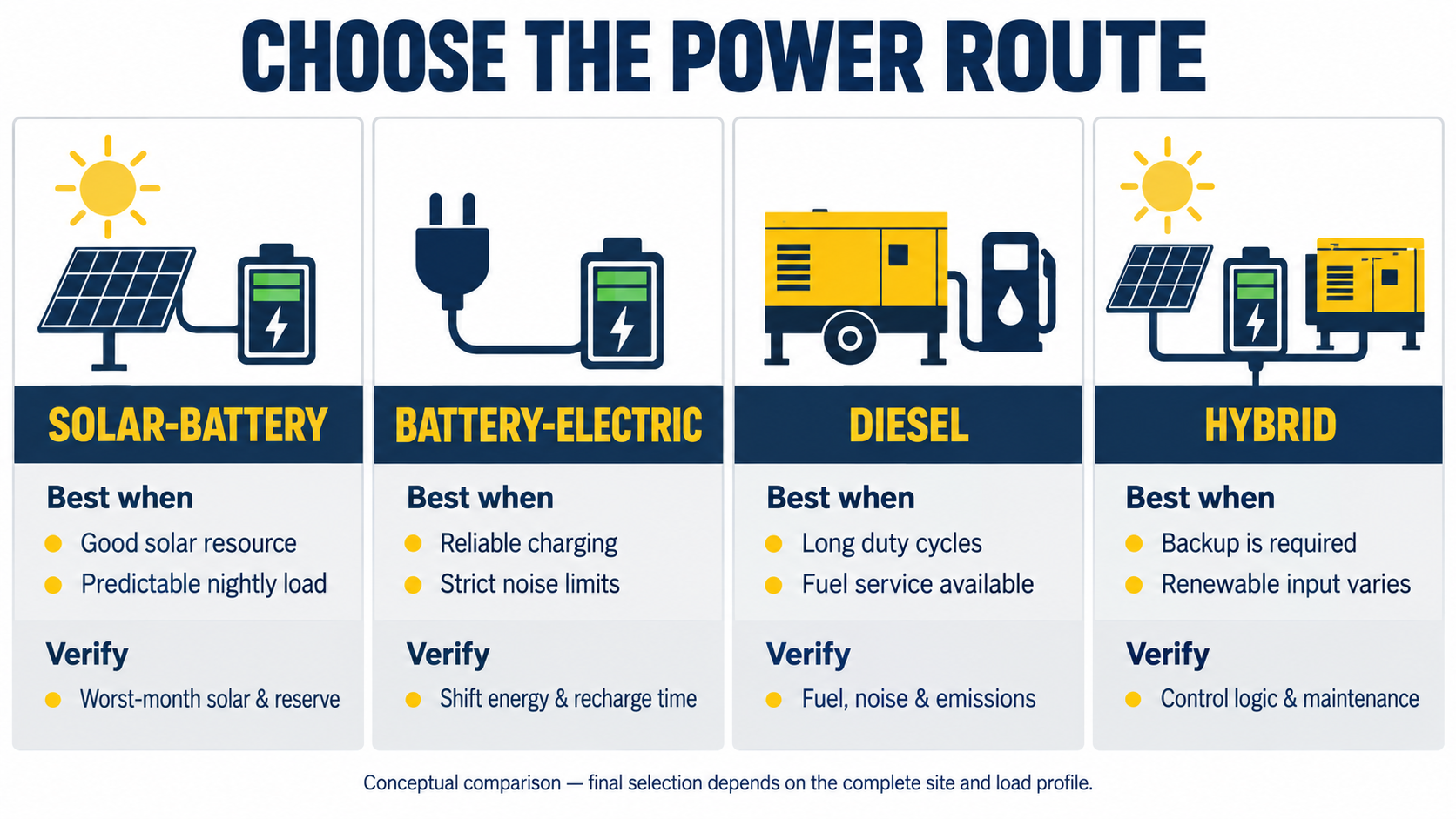
Direct answer: Solar-battery towers reduce routine fuel logistics when renewable input is sufficient; diesel systems support controllable long-duty operation but require fuel and engine maintenance; hybrids add a backup route; and battery-electric or grid-powered towers suit sites with a reliable charging source and strict noise limits. No power source is best for every site.
Use the table as an initial route, then verify the configuration against a complete load and site profile.
| Tower type | Best starting point when | Main strengths | Confirm before selection |
|---|---|---|---|
| Solar-battery | The load is predictable and the site has adequate solar access | No routine fuel delivery, low operating noise, fewer engine-service tasks | Worst-month solar resource, array size, battery Wh, usable DoD, charging time and reserve days |
| Battery-electric | Charging power is available or the shift energy is well defined | Quiet operation, no engine exhaust at the unit, simple start-up | Charging source, recharge time, temperature, battery ageing and full-shift autonomy |
| Diesel-generator | Long duty cycles and fuel logistics are already supported | Familiar refuelling model and continuous operation with planned fuel service | Fuel use, noise, emissions, tank runtime, engine service and auxiliary output |
| Solar-diesel hybrid | Renewable operation is preferred but backup is required | Can reduce generator running time while retaining a backup source | Control logic, generator start conditions, battery sizing, fuel use and maintenance |
| Solar-wind hybrid | The site has verified solar and usable wind resources | Two renewable inputs may complement each other in suitable locations | Wind-resource data, turbine siting, turbulence, maintenance and energy contribution |
| Grid/electric | Reliable site power is available | Avoids onboard fuel storage and can support controlled long-term use | Cable routing, grounding, protection, voltage/frequency and relocation limits |
Explore the current LUXMAN categories:
- Mobile solar lighting towers
- Solar-wind hybrid lighting towers
- Solar-diesel hybrid lighting towers
- Electric mobile lighting tower

A Practical Selection Matrix
Direct answer: Start with the site’s dominant constraint. Energy availability determines the power route, ground and transport conditions determine the chassis, and the lighting task determines mast height, optics and tower quantity. The matrix is a shortlist, not a final specification.
| Site condition | Recommended starting route | Why | Information still required |
|---|---|---|---|
| Remote site with good solar access and moderate nightly load | Solar-battery tower | Reduces dependence on delivered fuel | Coordinates, worst-month solar data, load profile and autonomy requirement |
| Continuous operation with uncertain renewable input | Hybrid or generator-backed configuration | Adds a controllable backup source | Required uptime, fuel access, noise/emissions rules and control strategy |
| Noise-sensitive work area with reliable charging | Battery-electric tower | Avoids engine noise during operation | Shift energy, recharge window and available electrical supply |
| Mine or quarry with rough internal roads | Reinforced off-road trailer or skid configuration | Better suited to impact, clearance and ground conditions | Tow route, slope, ground clearance, axle load and site vehicle rules |
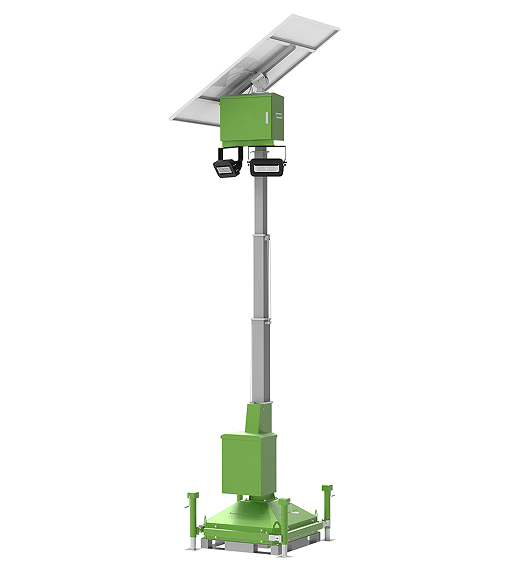
| Restricted access or frequent local repositioning | Compact hand-push tower | Smaller deployment footprint and easier local movement | Access width, surface, required mast height and work area |
| Public-road relocation between projects | Road-configured trailer | Supports repeated transport when correctly certified | Destination-market towing, brake, tyre, lighting and approval requirements |
How LUXMAN Approaches Demanding Outdoor Sites
LUXMAN’s mobile tower range covers light commercial use through demanding off-grid and mining applications. The following features apply only to confirmed configurations. Always verify the final model specification, drawings and applicable test evidence before ordering.
Dual-path mast lifting
Depending on the model, the mast may use a dual-wire-rope lifting architecture or another reinforced lifting system. Confirm the lifting method, rated load, locking mechanism, inspection schedule and allowable deployed wind condition.
Traceable core components
Solar and hybrid configurations can use industrial MPPT controllers, pure-sine-wave inverters and rechargeable battery storage. Confirm the component manufacturer, model, battery chemistry and substitution policy in the final bill of materials.
Reinforced mobility for rough sites
Heavy-duty trailers can use reinforced welded frames, upgraded suspension, off-road tyres and increased ground clearance. Confirm the chassis construction, load evidence, tyre and axle ratings, braking system and permitted towing conditions.
Layered corrosion protection
Confirmed corrosion-resistant configurations may use abrasive-blast preparation, galvanising, outdoor powder coating and treated exposed hardware. State the preparation grade, coating thickness and salt-spray performance only when the applicable process and test records are available. Laboratory results do not establish a universal rust-free field life.
Four-point deployment and modular service access
Selected towers use four adjustable outriggers to create a stable operating footprint. Separate battery, control and inverter compartments can simplify inspection. Confirm ground bearing, allowable slope, deployed footprint, wind limits and the exact enclosure covered by any IP rating.
View the LUXMAN lighting tower range for current product routes. Final performance depends on the confirmed model and project configuration.
Match the Tower to the Application
Construction and road work
Start with the work-zone layout, vehicle movement, required shift length and glare control. A towable configuration may suit projects that relocate frequently, while a compact tower can serve restricted-access work areas.
Mining and quarrying
Prioritise ground clearance, chassis durability, stability, corrosion exposure, service access and site towing rules. The lighting plan should consider moving equipment, reversing areas, work faces and shadows. Mine-specific requirements should be confirmed with the site operator and applicable regulator.
Emergency response
Deployment time, simple controls, compact transport and dependable stored energy may take priority. Emergency lighting used only for evacuation is not the same as task lighting for sustained work; the applicable safety rules depend on jurisdiction and environment.
Ports, rail and remote industrial work
Check wind exposure, salt or dust, long linear work zones, communications equipment and auxiliary loads. These loads must be included in the total energy calculation rather than treated as “free” inverter capacity.
Events and community areas
Noise, glare, visual comfort, cable management and public access may be more important than maximum output. A battery or solar-battery configuration can be a useful starting route if the energy budget and charging conditions are adequate.
Deployment and Procurement Checklist
Before ordering, confirm
- Task and area: Define the work activity, dimensions, target illuminance, uniformity and applicable standard.
- Energy profile: Provide operating hours, dimming schedule, auxiliary AC/DC loads, project coordinates and required reserve period.
- Mast and optics: Confirm working height, beam direction, deployment clearance and any overhead hazards.
- Environment: State wind, temperature, dust, rain, salt and other corrosion conditions.
- التنقل: Describe the ground, slope, access, relocation frequency, towing route and whether public-road approval is required.
- Evidence and service: Request the final specification, drawings, lighting data, applicable reports, maintenance plan, spare-parts support and warranty terms. Verify the delivered configuration and field performance where required.
Before raising the mast, verify
- Equipment condition: Inspect the mast, wire ropes, locks, luminaires, tyres, coupling and outriggers.
- Footprint and clearance: Confirm ground bearing, slope, drainage, full outrigger deployment and safe clearance from overhead lines.
- Weather: Check current and forecast wind against the permitted limit for the exact deployed state.
- Controlled deployment: Level the unit, establish an exclusion area and raise the mast according to the approved operating instructions.
- Light direction and shutdown: Aim luminaires to reduce glare and deep shadows. Lower and secure the mast before towing or when conditions exceed the operating limit.
Frequently Asked Questions
How do I choose the right mobile lighting tower?
If the project inputs are not yet defined, start with the work task, area geometry, required illuminance, shift duration, available energy, wind, terrain and transport route. Then compare configurations. Do not choose solely by lamp wattage, a claimed coverage area or maximum mast height.
When should I choose a solar light tower instead of a diesel model?
If the site has sufficient solar resource, a predictable energy demand and enough reserve capacity, a solar-battery tower may reduce fuel logistics and engine maintenance. If continuous operation is critical during prolonged poor weather or the load is high, a verified backup source or diesel/hybrid system may be more suitable.
How many lumens should a light tower have?
There is no reliable universal number. If you know the required lux, work-area geometry, mast height and optical distribution, a lighting calculation can estimate the required lumens and tower positions. Lumens alone do not establish ground-level illuminance or uniformity.
What mast height should I choose?
If a larger area and fewer obstructions favour a higher light source, a taller mast may improve distribution. It also increases wind exposure and deployment requirements. Confirm the lighting calculation, working height, mast mechanism, stability and allowable wind condition together.
Can a mobile light tower be towed on public roads?
Only if the exact trailer configuration complies with the destination market’s vehicle requirements. Confirm the coupling, axle, tyres, brakes, road lights, reflectors, dimensions, mass and approval documents before ordering. A brochure speed does not establish road legality.
When should I choose a hybrid lighting tower over a pure solar model?
If renewable operation is preferred but the site cannot accept loss of lighting during prolonged low-sun periods, a solar-diesel or another verified hybrid route may be appropriate. Compare the backup-control logic, generator runtime, fuel use, battery capacity, noise and maintenance against simply increasing solar and storage capacity.
Should I choose a trailer-mounted, skid-mounted or hand-push light tower?
If the unit must travel regularly between sites or on public roads, start with a properly configured trailer and verify local vehicle requirements. If it will remain on one site and move by forklift or crane, a skid base may be simpler. If access is narrow and the lighting demand is localised, consider a compact hand-push configuration.
Request a Configuration Review
Send LUXMAN your site plan or area dimensions, target lighting requirement, nightly operating schedule, project location, environmental conditions and transport requirements. We can use those inputs to identify a preliminary lighting-tower route, list the specifications that still require confirmation and prepare a configuration-based quotation.